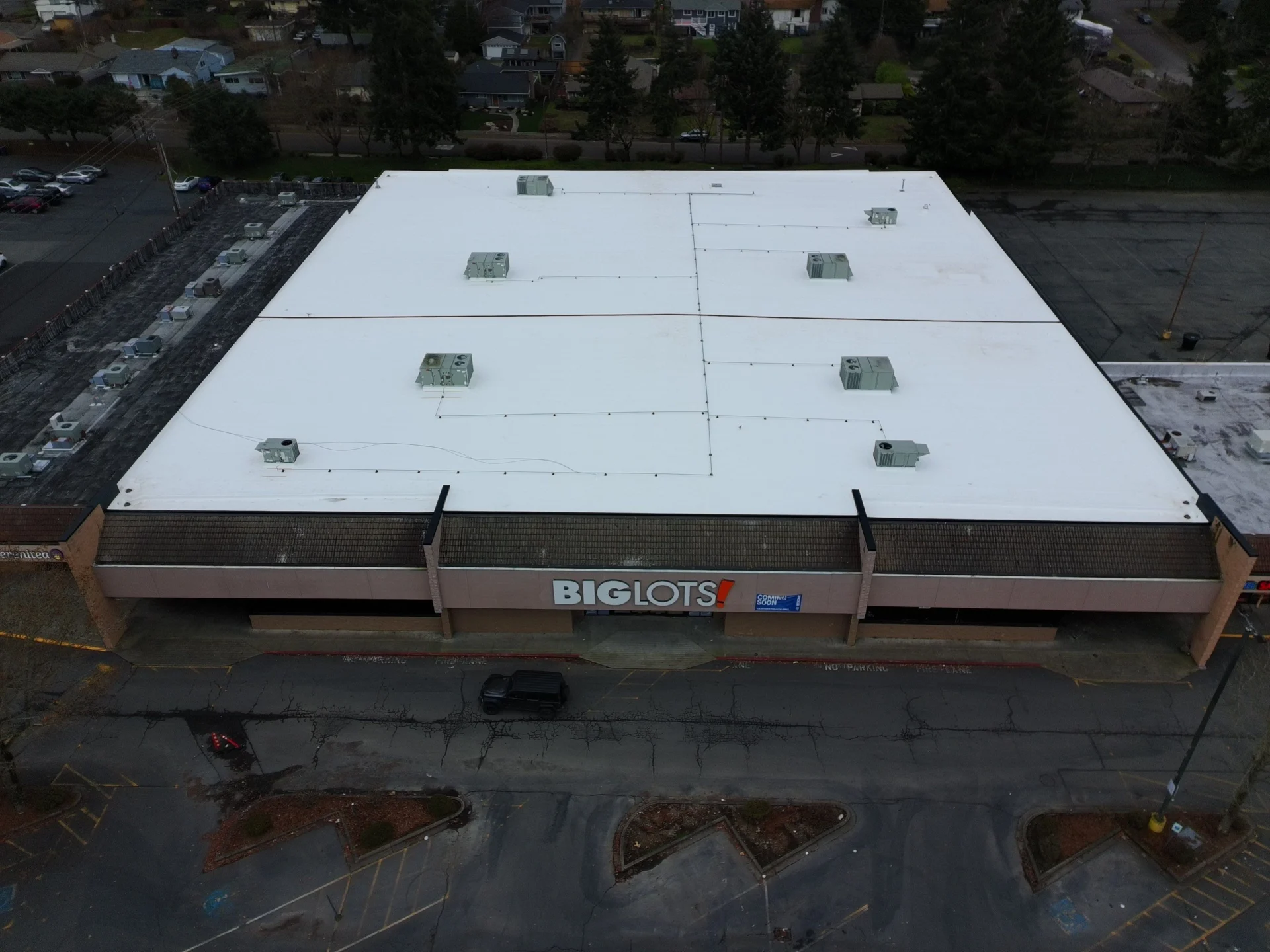
Most guides covering the types of roof materials focus on residential roofing options like shingles, tile, and slate. Commercial buildings, however, have different roofing requirements. Many commercial properties in Seattle and Tacoma feature low-slope roofs that must accommodate rooftop equipment, maintenance access, and the Pacific Northwest’s extended rainy season.
Below, we compare the different types of roof materials commonly used on commercial buildings throughout the Puget Sound region, including their advantages, limitations, and ideal applications. We’ll also explain what property owners should consider when selecting a roofing system for their building and budget.
Key takeaways
- Roof slope is one of the primary factors in selecting a roofing system, with waterproof membranes typically used for low-slope roofs and water-shedding materials for steep-slope applications.
- TPO is one of the most commonly installed commercial roofing systems, while PVC is often preferred for buildings with rooftop exposure to grease, oils, or certain chemicals.
- An aging torch-down roof is best replaced with a heat-welded TPO or PVC membrane, not another torch-down layer.
- Metal roofing is an excellent option for steep-slope commercial applications, offering durability, longevity, and aesthetic appeal.
- Drainage, flashing, and installation quality are just as important as material selection when it comes to long-term roof performance.
Start with roof slope, then building use
The National Roofing Contractors Association (NRCA) sorts roof systems into two groups based on slope and how they handle water. Low-slope systems are waterproof membranes installed on slopes of 3:12 or less, and steep-slope systems are water-shedding coverings installed on anything steeper. That split narrows the types of roof materials worth considering before price or brand comes up.
Most commercial roofs sit at the low end of that range, and NRCA’s technical staff identify 1/4:12 as the most common low-slope design slope in North America. It is also the minimum the International Building Code sets for new membrane roofs, except coal tar built-up systems. The Whole Building Design Guide goes further and recommends 1/2:12 wherever a building’s design allows it.
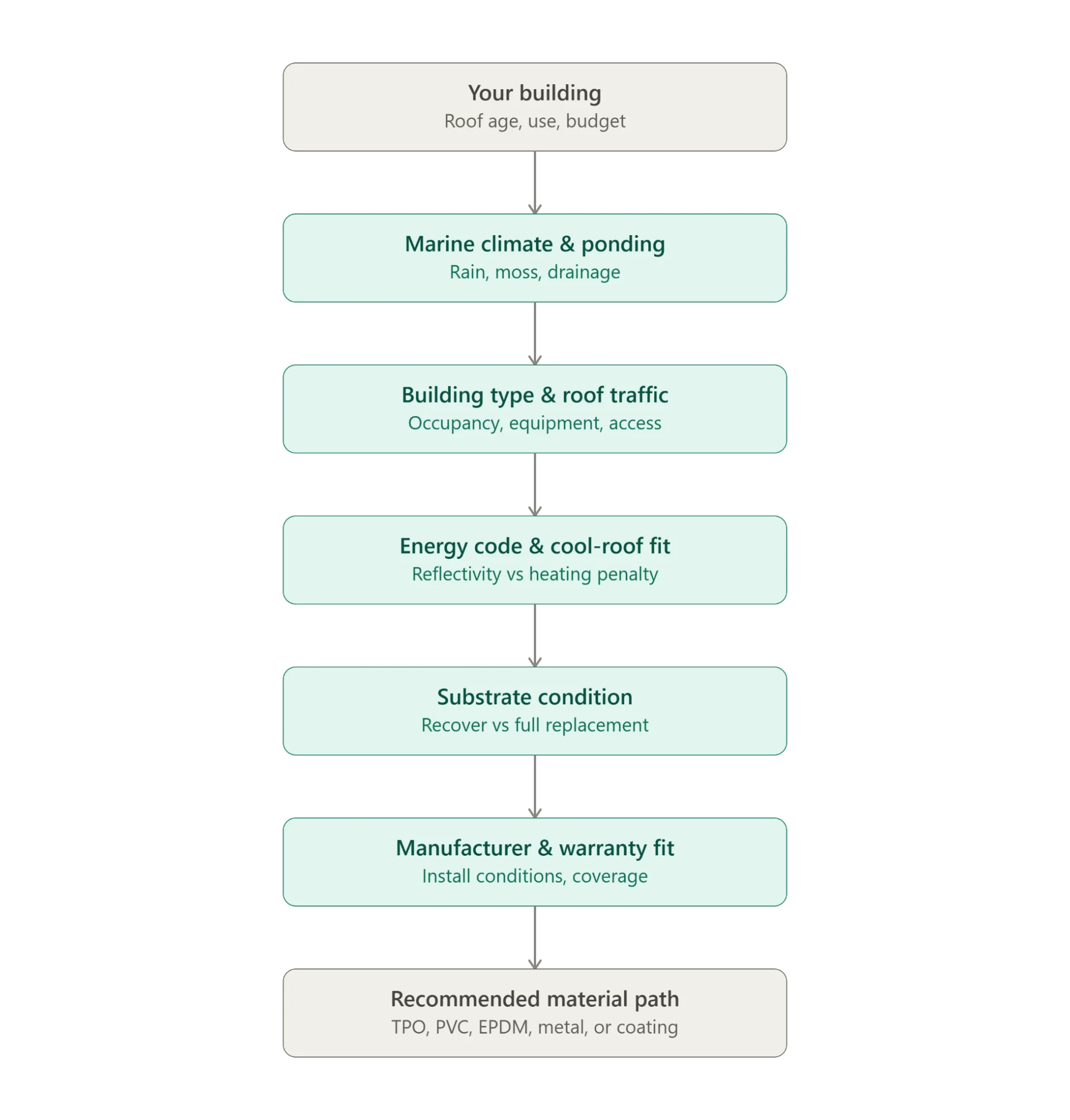
Before you compare systems, answer these questions about your building:
- Slope. Is the roof flat, steep, or a mix of both?
- Exposure. Do grease, oils, or chemicals from a kitchen exhaust or manufacturing process reach the roof surface?
- Traffic. How much HVAC and other equipment sits on the roof, and how often do technicians walk across it?
- Condition. Is the existing roof still dry and sound, or is it holding wet insulation under the membrane?
- Occupancy. Will tenants or staff remain in the building while the crew is on the roof?
- Horizon. How long do you plan to own the building before you sell or refinance?
“For flat and low-slope commercial roofs, we generally recommend TPO or PVC membrane systems because they provide continuous, watertight protection and are well-suited for roofs with multiple penetrations, HVAC equipment, and complex drainage requirements.”
Ivan Prokopets, Owner & CEO, Washington Weather Shield
Commercial roof materials compared at a glance
| System | Typical slope | How seams are joined | Puget Sound service life | Main weak point | Best fit |
| TPO | Low-slope (3:12 or less) | Heat-welded | 20–30 years | Seams, flashings, and penetrations if improperly installed | Most low-slope commercial roofs |
| PVC | Low-slope (3:12 or less) | Heat-welded | 20–30 years | Seams, flashings, and penetrations if improperly installed | Grease, oil, or certain chemical exposures |
| Roof coatings (silicone) | Low-slope and other compatible roof configurations | Seamless application with reinforced details where needed | 10–20 years, depending on system | Poor adhesion or premature failure from inadequate surface preparation | Restoring suitable existing commercial roofs without a full replacement |
| EPDM | Low-slope (3:12 or less) | Seam tape and adhesive | 20–30 years | Adhesive seams and flashing details | Low-slope commercial roofs |
| Torch-down / modified bitumen | Low-slope | Torch-applied or other approved application methods | 15–20 years | Cracking and failing seams on older roofs | Low-slope roofs; replacement or recover may be considered as the roof ages |
| Metal | Steeper slopes; some low-slope applications | Seams and fasteners | 40–60 years, depending on system | Corrosion where debris traps moisture | Steep or highly visible roofs |
| Asphalt shingles | Typically 4:12 and steeper; some systems permit lower slopes | Overlapping, water-shedding | 20–30 years | Premature deterioration and leaks if installed below minimum slope | Steep-slope sections only |
The service-life ranges in this chart are our estimates for the main types of roof materials on Puget Sound buildings, based on roofs we have inspected and replaced. We lean on field results on purpose. NRCA holds that “documented in-place performance is the primary indicator of a roof system’s service life.” A well-installed, maintained roof can beat these ranges, and a neglected one can fail years early.
Types of flat roof materials for low-slope commercial roofs
Until the mid-to-late 1970s, almost every low-slope roof was asphalt or coal tar built-up roofing, according to the Whole Building Design Guide. Modified bitumens, single-ply membranes, spray foam, metal panels, and liquid-applied membranes began competing with it over the next two decades. That history explains why today’s list of commercial flat roof materials is longer than most owners expect.
Key stat: Flat roofs sit on about 1.9 million U.S. commercial buildings, roughly 32% of the total. Those buildings hold 54.3 billion square feet, about 56% of all commercial floorspace, according to the U.S. Energy Information Administration’s 2018 CBECS.
Membranes lead that space. The same EIA survey puts synthetic or rubber roofs, which include TPO, PVC, and EPDM, on 31.6 billion of 96.4 billion square feet. That works out to about 33% of surveyed floorspace, more than any other single roof material. The median building with one of these roofs has 9,500 square feet of floorspace, compared with 5,000 for metal, demonstrating how commonly membranes are used on larger commercial buildings.
Below, we compare four common low-slope roofing systems found on Puget Sound commercial roofs, along with roof coatings as a restoration option. Washington Weather Shield specializes in TPO and PVC installations and commercial roof coatings, while also inspecting and replacing aging EPDM and modified bitumen systems. Comparing types of roof materials with pictures makes the differences in seams, surfaces, and applications easier to understand.
TPO

TPO (thermoplastic polyolefin) is a single-ply membrane, meaning one factory-made sheet instead of several built-up layers. It is the system we specify most often for low-slope buildings because it offers an excellent balance of performance and cost. Its seams are heat-welded, so hot air fuses overlapping sheets together to create strong, watertight seams.
We typically install 60-mil membrane, and most of the TPO roofing we install is mechanically attached with fasteners and plates. A properly installed system can qualify for a 20-year manufacturer NDL (no-dollar-limit) warranty covering labor and materials, subject to warranty terms. For building owners seeking longer warranty coverage, upgrading to an 80-mil TPO membrane can qualify the roof for a 25-year manufacturer NDL warranty, provided the roofing system meets GAF’s requirements. With routine maintenance and proper drainage, a TPO roof can provide 20 to 30 years of service in the Puget Sound region.
PVC
PVC (polyvinyl chloride) shares TPO’s heat-welded seams and its 20-to-30-year service range on Puget Sound roofs. It generally costs more upfront. One of its biggest advantages is its resistance to grease, oils, and certain chemicals that can deteriorate other roofing membranes. That makes it an excellent choice for restaurants, manufacturing facilities, and other buildings where rooftop exposure to these substances is a concern.
As a Duro-Last authorized installer, Washington Weather Shield offers PVC roofing systems that can qualify for manufacturer NDL (no-dollar-limit) warranties of up to 25 years with 60-mil membrane or 30 years with qualifying 80-mil membrane systems, subject to manufacturer requirements and approval.
Silicone roof coatings
Silicone roof coatings are liquid-applied roofing products designed to restore and extend the service life of suitable existing commercial roofs. Unlike a full roof replacement, a coating system is applied over an existing roof surface, creating a seamless, protective layer that helps prevent water intrusion and withstand prolonged exposure to UV rays and moisture.
At Washington Weather Shield, we install GE Enduris silicone roof coating systems on qualifying commercial roofs throughout the Puget Sound region. When the existing roof is structurally sound and suitable for restoration, coatings can provide a cost-effective alternative to a complete tear-off and replacement. Depending on the system and application requirements, silicone roof coatings may qualify for manufacturer warranties of up to 20 years.
EPDM
EPDM (ethylene propylene diene monomer) is a synthetic rubber membrane with a typical service life of 20 to 30 years. One of its main differences from TPO and PVC is how the seams are joined. EPDM sheets are bonded using seam tape and adhesives, while TPO and PVC sheets are welded together with heat. Over time, improperly installed or deteriorating seams can become vulnerable to separation and leaks.
Although Washington Weather Shield does not install new EPDM roofing systems, we regularly encounter them when inspecting existing commercial roofs and evaluating replacement options.
Torch-down and modified bitumen
Torch-down roofing is a type of modified bitumen system made from polymer-modified asphalt sheets that are fused in place using an open-flame torch. Other modified bitumen systems use different installation methods. These roofs typically have a service life of 15 to 20 years, although properly maintained systems can last longer. On older torch-down roofs, we commonly find cracking along with deteriorating seams, flashings, and sealants.
When replacing an aging torch-down roof, we generally recommend upgrading to TPO or PVC rather than installing another torch-down system. Heat-welded single-ply seams eliminate the need for an open flame during seam welding, reducing fire risks during installation. Qualifying TPO and PVC systems can also carry manufacturer NDL warranties covering labor and materials for 20 years or longer, depending on the system and manufacturer.
“We consider torch-down roofing to be an outdated option compared to today’s single-ply membrane systems, which offer excellent durability, long-term waterproofing performance, and heat-welded seams that create strong, watertight bonds.”
Ivan Prokopets, Owner & CEO, Washington Weather Shield
Metal types of roof materials for steep and visible slopes
Steep-slope roofs shed water more quickly than low-slope roofs, which influences the types of roofing materials used and where potential vulnerabilities may develop.
Metal roofing
Metal is one of the longest-lasting roofing systems we install, with a 40-to-60-year range depending on the system and its maintenance. It sheds water quickly on steeper slopes and gives a clean look where the roof is visible from the ground. Those are the buildings where we usually recommend metal over a membrane, especially when appearance matters to the owner. We install two metal systems. Standing seam keeps its fasteners concealed and gives a cleaner finish, while exposed-fastener panels cost less and suit many industrial and agricultural-style buildings.
With steel roof materials and other metal panels, accumulated debris traps moisture around seams, fasteners, and flashings. Over time, prolonged moisture exposure can contribute to corrosion, particularly where protective coatings are damaged. Metal panels can also serve some low-slope roofs, according to the Whole Building Design Guide. On flat roofs crowded with HVAC units and drains, though, we generally choose a membrane.
Asphalt shingles
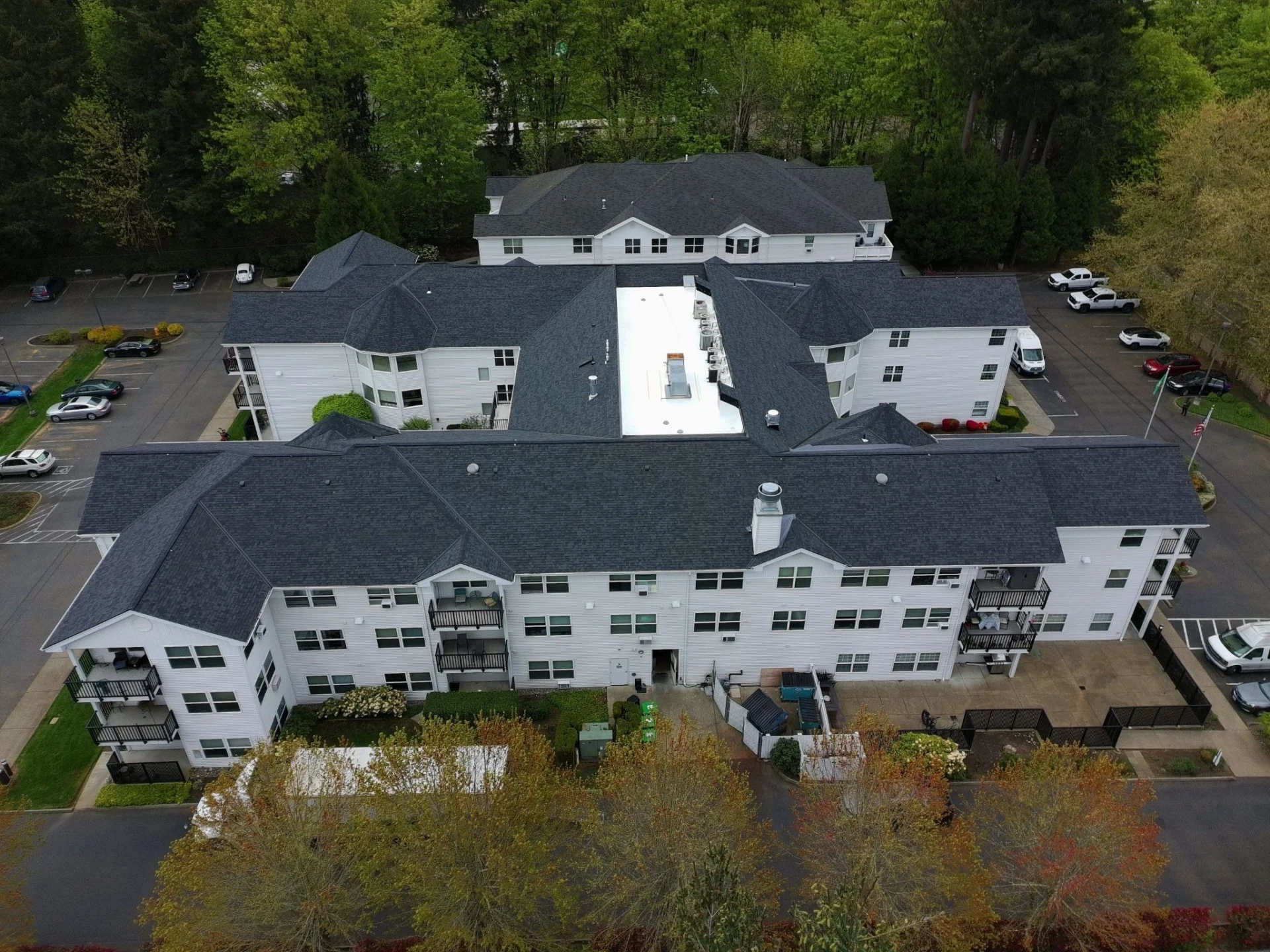
Asphalt shingles typically last 20 to 30 years in the Puget Sound region when installed on an appropriate roof slope. The right roof is steep. Some shingle manufacturers and model building codes allow asphalt shingles on roofs with a slope as low as 2:12. NRCA does not recommend them below 4:12, because shingle systems rely on gravity and slope to drain water.
We sometimes encounter shingles installed on commercial roof sections with insufficient slope or inadequate underlayment, which can contribute to premature leaks and deterioration. Moss growth can also become an issue in the Pacific Northwest, particularly on shaded roofs where leaves and other debris retain moisture.
Buildings with Both Flat and Steep-Slope Roofs
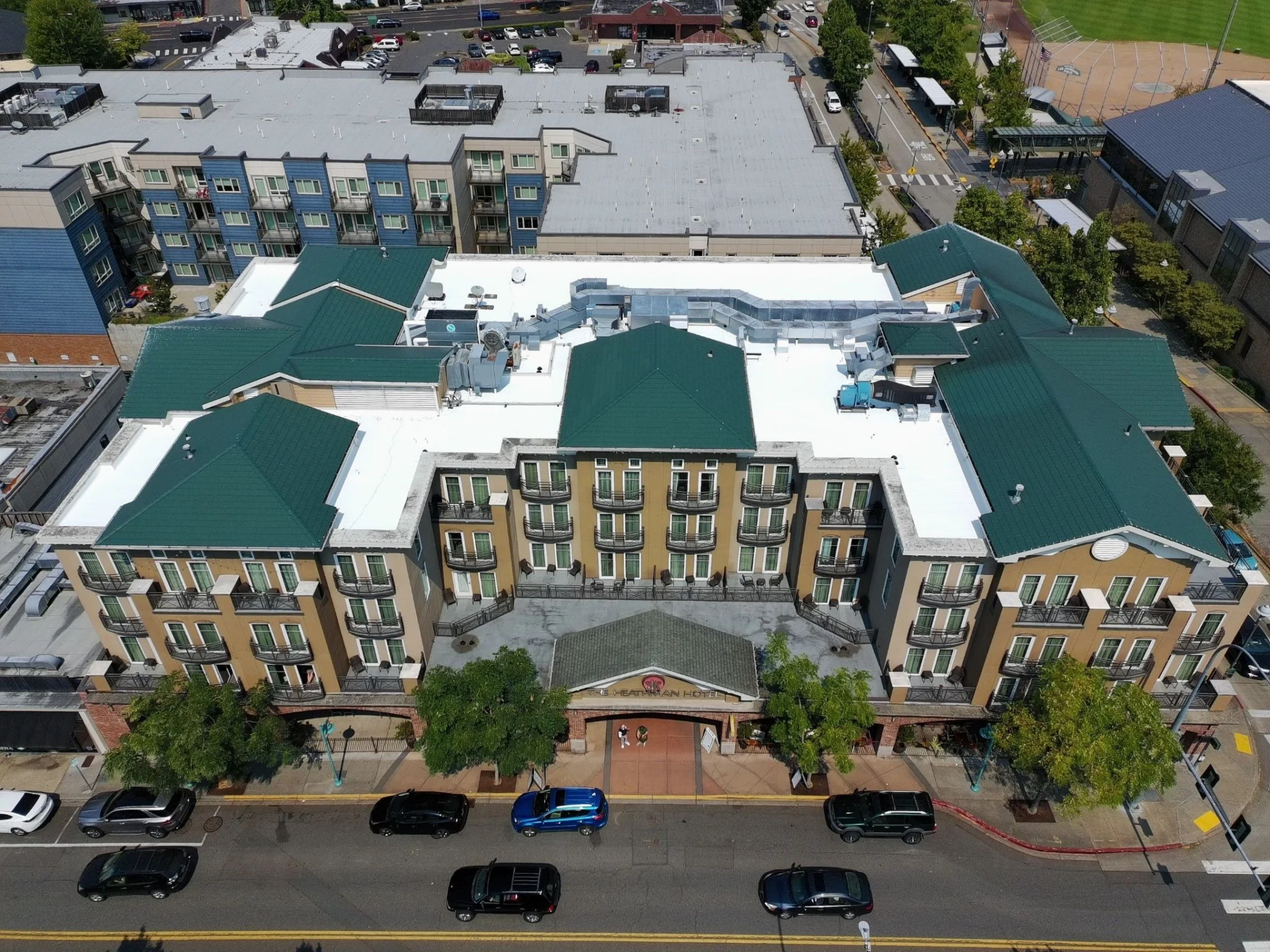
On buildings with both low-slope and steep-slope roof sections, we typically pair TPO or PVC membranes on the low-slope areas with metal or asphalt shingles on the steeper sections. One of the most vulnerable areas is where the two roofing materials meet. These transitions require careful flashing, proper membrane integration, and secure connections to prevent water intrusion at the joint.
How do roof materials perform in Puget Sound’s rainy climate?
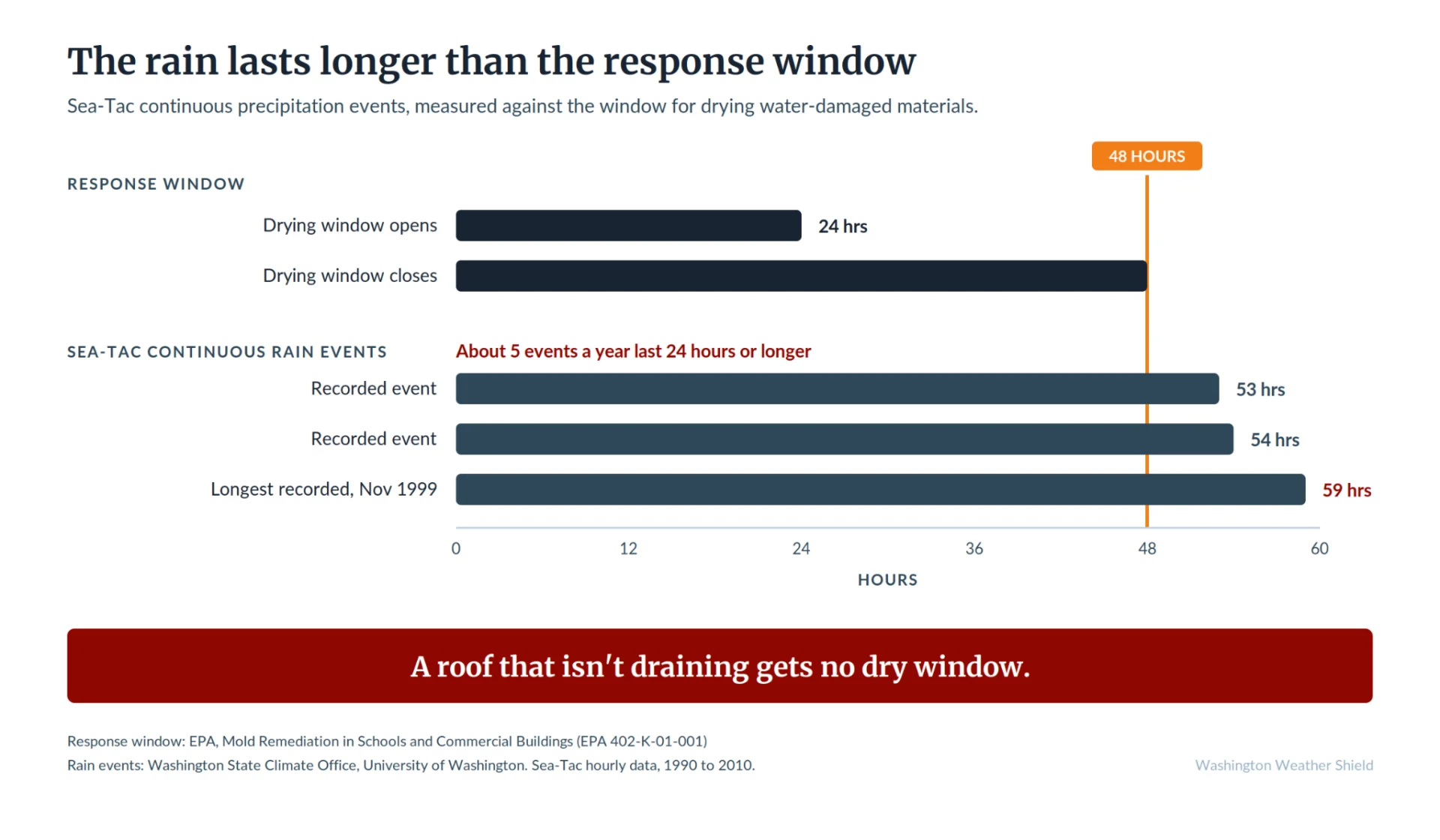
The UW Climate Impacts Group reports that the Puget Sound lowlands averaged 43.6 inches of precipitation a year from 1950 to 1999. Heavy storms appear to be getting heavier, too. One study the group cites found a statistically significant 23% increase in the region’s annual-maximum 48-hour rain event between 1956–1980 and 1981–2005.
On a low-slope roof, prolonged rainfall makes three factors especially important:
- Seams under standing water. Heat-welded TPO and PVC seams provide strong, watertight protection, even during periods of ponding. Properly installed EPDM seams can also perform well, but all membrane systems depend on sound seams, flashing details, and adequate drainage. Once water gets past a seam, the insulation below can become saturated before visible signs of a leak appear inside.
- Debris and moss. On membrane roofs, leaves clog drains and scuppers, and the resulting ponding can contribute to premature deterioration. On metal roofs, wet leaves and debris hold moisture at seams and fasteners, which can contribute to corrosion. We recommend professional roof cleaning twice a year: once in late fall after the leaves drop, and again in late winter or early spring.
- Installation weather. Every roofing system has specific weather and substrate requirements. Crews must follow manufacturer guidelines for temperature, moisture, and surface preparation. Coatings are particularly weather-sensitive during application, which is why we typically schedule coating projects during the drier months of late spring and summer.
Even the best roof waterproofing materials can fail when water has nowhere to go. That is why slope, drains, scuppers, and flashing details deserve as much attention in a roofing proposal as the membrane itself.
Does a white membrane pay off under Puget Sound skies?
White TPO or PVC is our default because it reflects sunlight and reduces heat gain during the warmer months of the year. Gray is the most popular second choice with our clients, and it provides comparable waterproofing performance when installed as part of an equivalent roofing system. The energy case for white membranes is weaker here than in hot climates. As the U.S. Department of Energy notes, “cool roofs can also incur a winter heating penalty.”
In our cool, cloudy marine climate, we recommend TPO for its waterproofing, service life, and value, rather than energy savings alone. Insulation also plays a significant role in how much energy a building uses through a Puget Sound winter. If you choose white, proper drainage and routine cleaning can help preserve its reflective properties.. NRCA research on in-service roofs has also examined how drainage conditions affect long-term roof reflectance.
Which kinds of roof materials fit your building type?
| Building situation | What we usually recommend | Why |
| Warehouse or distribution building with a large low-slope roof | TPO | Best balance of performance and cost |
| Restaurant or food service building | PVC | Resists grease and oils from kitchen exhaust |
| Manufacturing or industrial facility with oil or chemical exposure | PVC | Chemical resistance, subject to compatibility |
| Office or retail building with dense rooftop HVAC | TPO or PVC | Suited to roofs with many penetrations and complex drainage |
| Occupied building replacing a torch-down roof | TPO or PVC | No open flame required for membrane seam welding |
| Building with steep, visible roof sections | Metal or asphalt shingles | Sheds water and suits a visible roofline |
| Mixed-slope building | Membrane on low sections, metal or shingles on steep ones | Each material matched to its slope, with transitions detailed carefully |
| Existing roof that is still dry and sound | Silicone coating, after testing | Extends service life without a tear-off when suitable |
This matrix reflects what we usually recommend for each situation, before a site visit confirms the details for your specific roof.
When a coating makes more sense than a new roof
A roof coating is a restoration option for an existing roofing system that remains in suitable condition, rather than a complete roof replacement. Liquid-applied roofing has been part of the International Building Code since its 2012 edition, according to the Whole Building Design Guide. We install GE Enduris silicone coatings and perform adhesion tests before recommending a coating system, since compatibility on paper does not always guarantee proper adhesion to an existing roof.
In many cases, property owners assume they need a complete tear-off when a silicone coating could extend the life of their existing roof at a lower cost. However, coatings are not appropriate for every situation, particularly when the underlying roof has saturated insulation or significant deterioration. We also encounter aluminum “silver” coatings that have been applied as a waterproofing solution, although these products are generally intended to provide reflective protection rather than serve as a standalone waterproofing membrane.
Why the lowest bid rarely means the lowest cost
Two proposals for the same roof can look alike on the first page and protect your building very differently. Price differences often come down to the scope of work. Before comparing totals, consider these details:
- Tear-off or recover. Is the existing roof being removed, or will the new roofing system be installed over it?
- Deck repairs. How does the proposal address damaged or deteriorated decking discovered during the project?
- Insulation upgrades. Does the scope include any insulation upgrades necessary to meet applicable building codes, improve energy efficiency, or satisfy manufacturer requirements?
- Drainage improvements. Does the proposal address existing drainage issues, such as areas of persistent ponding water?
- Flashing details. Are penetrations, curbs, parapets, and transitions clearly addressed in the scope of work?
- Warranty. What type of manufacturer warranty is included, how long does coverage last, and does it cover both labor and materials?
Many commercial roof leaks develop around penetrations, flashings, seams, and other critical details rather than in the open field of the roof. Cutting corners in these areas may reduce upfront costs but lead to expensive repairs down the road. The total cost of ownership also includes expected service life, maintenance, energy efficiency, and potential disruptions from future repairs.
Choosing materials for a roof you will own for 20 years is a different calculation from patching one you plan to sell next year.
Frequently asked questions
What are the top 5 roofing materials?
Five common roofing materials used on commercial buildings are TPO, PVC, EPDM, metal, and modified bitumen. According to the EIA’s 2018 CBECS, synthetic or rubber membranes account for approximately 33% of U.S. commercial building floorspace, making them one of the most widely used roofing material categories. The best choice depends on the building’s roof slope, use, and long-term performance requirements.
What are the different types of roofing materials?
Commercial roofing systems generally fall into two main categories based on roof slope. Common types of roof materials for low-slope applications include TPO, PVC, EPDM, modified bitumen, and built-up roofing, while steep-slope systems typically include metal roofing and asphalt shingles. Silicone and other liquid-applied coatings provide an additional option for restoring and extending the life of suitable existing roofing systems.
What is better, TPO or EPDM?
TPO, for most low-slope roofs in the Puget Sound. Both last 20 to 30 years, but TPO’s heat-welded seams hold up better under ponding water than EPDM’s taped and adhered seams. TPO is also one of the most cost-effective commercial systems we install, which is why we recommend it most.
What is the most expensive roof material?
Premium standing seam metal roofing is often among the most expensive commercial roofing materials upfront, particularly on complex roof designs. Among low-slope systems, PVC generally costs more than TPO, while a complete tear-off typically costs more than a recover when the existing roof qualifies. However, the lowest initial price doesn’t always mean the lowest long-term cost. Expected service life, maintenance, and potential future repairs should all factor into the decision.
Matching the types of roof materials to your building
No single material is the best fit for every commercial building. Roof slope narrows the
types of roof materials to consider, while building use, drainage, and long-term performance goals help determine the most appropriate system. For most low-slope commercial roofs in the Puget Sound region, we recommend TPO for its balance of durability and cost, with PVC often preferred where grease, oils, or certain chemicals are present. Metal and asphalt shingles are well-suited for steep-slope applications, while silicone coatings can extend the life of suitable existing roofs without a complete replacement.
If you manage a commercial property in Seattle, Tacoma, or anywhere in the nine counties we serve, we can assess your roof. Request a free roof assessment or call 206-504-1500 to discuss which roofing system is best suited for your building.
References
- Crowe, J. P. (2013). Who you gonna call? Professional Roofing, National Roofing Contractors Association. https://professionalroofing.net/articles/article/2251
- Mauger, G. S., et al. (2015). State of Knowledge: Climate Change in Puget Sound, Section 2: Climate. Climate Impacts Group, University of Washington. https://data.cig.uw.edu/picea/mauger/ps-sok/ps-sok_sec02_climate_2015.pdf
- National Institute of Building Sciences. (n.d.). Building Envelope Design Guide: Roofing Systems. Whole Building Design Guide. https://wbdg.org/node/399
- Rupar, M. (2017). Not as cool as advertised. Professional Roofing, National Roofing Contractors Association. https://professionalroofing.net/articles/article/4034
- U.S. Department of Energy. (n.d.). Cool Roofs. Energy Saver. https://www.energy.gov/energysaver/cool-roofs
- U.S. Energy Information Administration. (2021, revised 2022). 2018 Commercial Buildings Energy Consumption Survey, Table B2. https://www.eia.gov/consumption/commercial/data/2018/bc/html/b2.php