If you’re comparing roofing proposals for your commercial building, you may keep seeing the same material: TPO.
But what would a TPO roofing system mean for your building?
For Seattle building owners, that means looking at how the system handles long wet seasons, what installation involves, and what to expect from maintenance and cost. This guide explains TPO roofing, compares it with PVC and EPDM, and outlines what to consider before you choose.
Key takeaways
- TPO fits most low-slope commercial roofs in Greater Seattle. Steep slopes and roofs exposed to grease or chemicals are better served by other systems.
- In our experience, a properly installed and maintained TPO roof lasts 20 to 30 years in the Puget Sound climate.
- In our cloudy climate, TPO earns its place through waterproofing and long-term value, with energy savings as a smaller bonus.
- Most leaks start at seams, flashings, and drains.
- TPO is low-maintenance, but it still needs two professional inspections a year, which also protect your warranty.
What is TPO roofing material made of?
TPO stands for thermoplastic polyolefin, a single-ply membrane reinforced with a fabric scrim that goes down in overlapping sheets. Under ASTM D6878, the industry specification for TPO sheet, the membrane must contain that reinforcement and bond to itself to form watertight seams and repairs.
The surface is usually white, which helps reflect sunlight. Heat welding joins the overlapping sheets without relying on tape or glue at the seams.
Why no two TPO membranes perform the same
ASTM D6878 sets minimum requirements for TPO roofing membranes, including reinforcement and seam strength. Meeting that standard establishes a baseline, but it doesn’t mean every membrane will perform the same.
Formulation, thickness, and manufacturing can affect performance. When comparing proposals, look beyond the TPO label and review the specific membrane being offered.
In a 2010 Professional Roofing column, Mark S. Graham, NRCA’s associate executive director of technical services, raised concerns about TPO membrane performance and advised specifiers to request product-specific data from suppliers. That remains a useful step when comparing roofing proposals.
Thickness is one choice you can make when reviewing a proposal. We specify 60-mil TPO on most commercial buildings we roof because it balances puncture resistance and cost. For roofs with heavy foot traffic or crowded rooftop equipment, we step up to 80-mil for added puncture protection at a higher material cost. Confirm the warranty terms for the proposed roof assembly, including eligibility for a 20-year manufacturer NDL (no dollar limit) labor and material warranty.
“One common misconception is that all TPO roofing systems are essentially the same, regardless of membrane thickness, manufacturer, or installation quality.”
Rita Prokopets, COO, Washington Weather Shield
Where TPO roofing systems fit in commercial roofing
TPO is one of several membrane roofing options used on low-slope commercial buildings, alongside PVC and EPDM. Federal survey data shows how common these materials have become, though it groups them together rather than measuring TPO separately.
The U.S. Energy Information Administration’s 2018 Commercial Buildings Energy Consumption Survey (CBECS) puts these materials in a “synthetic or rubber” category that covers about 33% of U.S. commercial floorspace.
For buildings completed from 2010 to 2018, that share rises to about 42%, compared with about 25% for buildings built before 1946. In the Pacific region, which includes Washington, the same survey estimates that roughly 15% of commercial buildings use a membrane as their main roof.
How TPO performs through a Puget Sound wet season
On Puget Sound roofs, water is the main threat, and standing water finds a weak seam before anything else does. In our experience, TPO and PVC perform very well under ponding water because their seams are heat-welded. EPDM’s taped and adhered seams are more prone to separating as they age.
In 2001, the Western States Roofing Contractors Association (WSRCA) installed TPO test roofs in Anchorage, Las Vegas, San Antonio, and Seattle. The Seattle site was classed as moderate with wet and dry periods, and the National Research Council of Canada analyzed samples from all four roofs. Heading into the fifth year, the researchers reported: “All seams remain welded, and all roofs are leak free.” The test membranes were 60-mil white TPO, the same thickness we specify today.
Realistic lifespan for a TPO roof in a wet climate
Key stat: 20 to 30 years. In our experience, properly installed and maintained TPO roofs across the Puget Sound region provide 20 to 30 years of service. Installation quality, drainage, and ongoing maintenance all influence where a roof falls within that range.

The WSRCA study discussed above documented early performance, but its authors said it was too soon to predict the membranes’ life expectancy. Our 20-to-30-year estimate reflects our field experience rather than a lifespan established by that study.
Service life and warranty coverage also mean different things. A 20-year manufacturer NDL warranty provides coverage under its specific terms; it does not establish the roof’s expected lifespan. Review the proposed warranty for covered issues, maintenance requirements, and exclusions.
Where TPO falls short, and when another membrane fits better
| TPO | PVC | EPDM | |
| Seam method | Heat-welded | Heat-welded | Seam tape and adhesive |
| Drainage considerations | Requires proper slope and drainage | Requires proper slope and drainage | Requires proper slope and drainage |
| Grease, oil, and chemicals | We recommend PVC | Superior resistance | We recommend PVC |
| Our recommendation | Our usual choice for low-slope commercial roofs | Consider where grease or chemical exposure calls for it | We favor TPO’s heat-welded seams for our commercial roofing projects |
A TPO roofing system fits most low-slope commercial roofs we see across our nine-county service area, but some buildings need a different approach. Grease and chemical exposure may call for PVC, while steep slopes require a roofing system designed for that pitch.
TPO vs PVC roofing for grease, oil, and chemical exposure
We recommend evaluating PVC when a roof is regularly exposed to grease, oil, or chemicals. Common examples include restaurants with kitchen exhaust and certain manufacturing or industrial facilities. The specific substances involved matter, so we check the membrane manufacturer’s compatibility guidance before recommending a system.
For low-slope roofs without those exposures, TPO remains our usual recommendation.
TPO roofing vs EPDM on ponding-prone roofs
TPO uses heat-welded seams, while EPDM typically relies on seam tape and adhesive. For the low-slope commercial roofs we install in the Puget Sound region, we favor TPO’s welded seams.
Standing water still needs attention. A membrane choice alone will not correct poor drainage, so the roofing proposal should address blocked drains, low areas, and slope where needed.
Questions to answer before you choose TPO
Use these questions to review the recommendations in each bid. The right approach depends on your roof’s condition, use, and exposure.
| Question about your building | What to consider | Why it matters |
| Does grease, oil, or chemical exhaust reach the roof? | PVC, subject to compatibility with the specific substances | Exposure may call for a different membrane. |
| Does the roof get heavy foot traffic or have equipment that needs regular servicing? | 80-mil TPO with designated walkway protection | A thicker membrane adds puncture resistance, while walkways help protect service routes. |
| Is the roof steep or pitched? | A system designed for the roof’s slope, such as metal or asphalt shingles | Roof pitch helps determine which systems are suitable. |
| Is the existing roof sound, with dry insulation? | Evaluate a coating or roof recover | A condition assessment and moisture testing help determine whether the existing roof can stay in place. |
| Is it a low-slope roof without unusual exposure or traffic? | 60-mil TPO as a starting point | This is our usual recommendation for balancing performance and cost, subject to the roof assessment. |
Does a white TPO roofing membrane save energy in Seattle?
White TPO roofing material reflects sunlight and can reduce cooling demand during warmer months. In Seattle, the benefit is smaller than in hot, sunny regions. We recommend TPO primarily for waterproofing and long-term value, with insulation playing an important role in the building’s overall energy performance.
A 2010 Lawrence Berkeley National Laboratory study examined the tradeoff: reflective roofs can reduce cooling energy use, but they may also increase heating demand in colder climates. The potential savings for your building depend on its insulation, heating and cooling systems, and use.
Seattle’s climate also makes moisture management important. A 2011 NRCA conference paper, hosted by Oak Ridge National Laboratory, examined condensation and drying concerns in reflective, mechanically attached roof assemblies.
The takeaway is to evaluate the whole roof assembly. Insulation, air leakage control, and moisture management belong in the design alongside the membrane.
Why color and cleanliness affect reflectivity
Washington Weather Shield installs white TPO most often because it reflects more sunlight than darker surfaces. Other TPO roofing colors are available, though options vary by manufacturer.
Surface dirt lowers reflectivity over time, though the WSRCA field data is reassuring. Before any cleaning, every test roof still exceeded ENERGY STAR’s reflectivity requirement for three-year-old membranes. Cleaning raised reflectivity at every site, but no membrane returned to its original whiteness. Scrubbing with stiff brooms or brushes left a slightly cleaner, more reflective surface than pressure rinsing.
How TPO roofing is installed in our climate
Installation is where TPO earns or loses its service life. On every project, three things decide the outcome: the attachment method, the detail work, and the weather window.
Mechanically attached or fully adhered: what drives the choice
Most of the TPO roofing systems we install on commercial buildings in the region are mechanically attached. Fasteners and plates secure the membrane to the roof assembly, and the seams between sheets are heat-welded into a watertight bond.
The right method depends on the roof deck, structure, wind uplift requirements, and manufacturer specs. Some buildings call for a fully adhered system, which bonds the membrane to the substrate with adhesive, and induction welding and ballast are two other options. We determine the method during the site assessment for a given commercial TPO roofing installation, once we know the deck type and uplift requirements.
TPO roofing installation details that help prevent leaks
Seams, flashings, and roof edges deserve close attention during installation. Pipes, vents, drains, HVAC curbs, parapet walls, skylights, and transitions between roof levels all create connections that need to stay watertight as the roof moves and weathers.
When inspecting roofs installed by other contractors, we often find incomplete seam welds and missing T-joint patches—the small reinforcing patches used where three membrane sheets overlap. We also find missing or poorly installed counterflashing, which helps keep water from entering behind the roof flashing.
Parapet coping can create another entry point. Unsealed joints in the metal cap or a wall top that does not slope toward the roof can allow water into the wall assembly.
Meeting a membrane material standard does not establish the quality of these installation details. ASTM D6878 addresses the TPO sheet itself; the finished roof also depends on properly installed seams, flashings, and drainage.
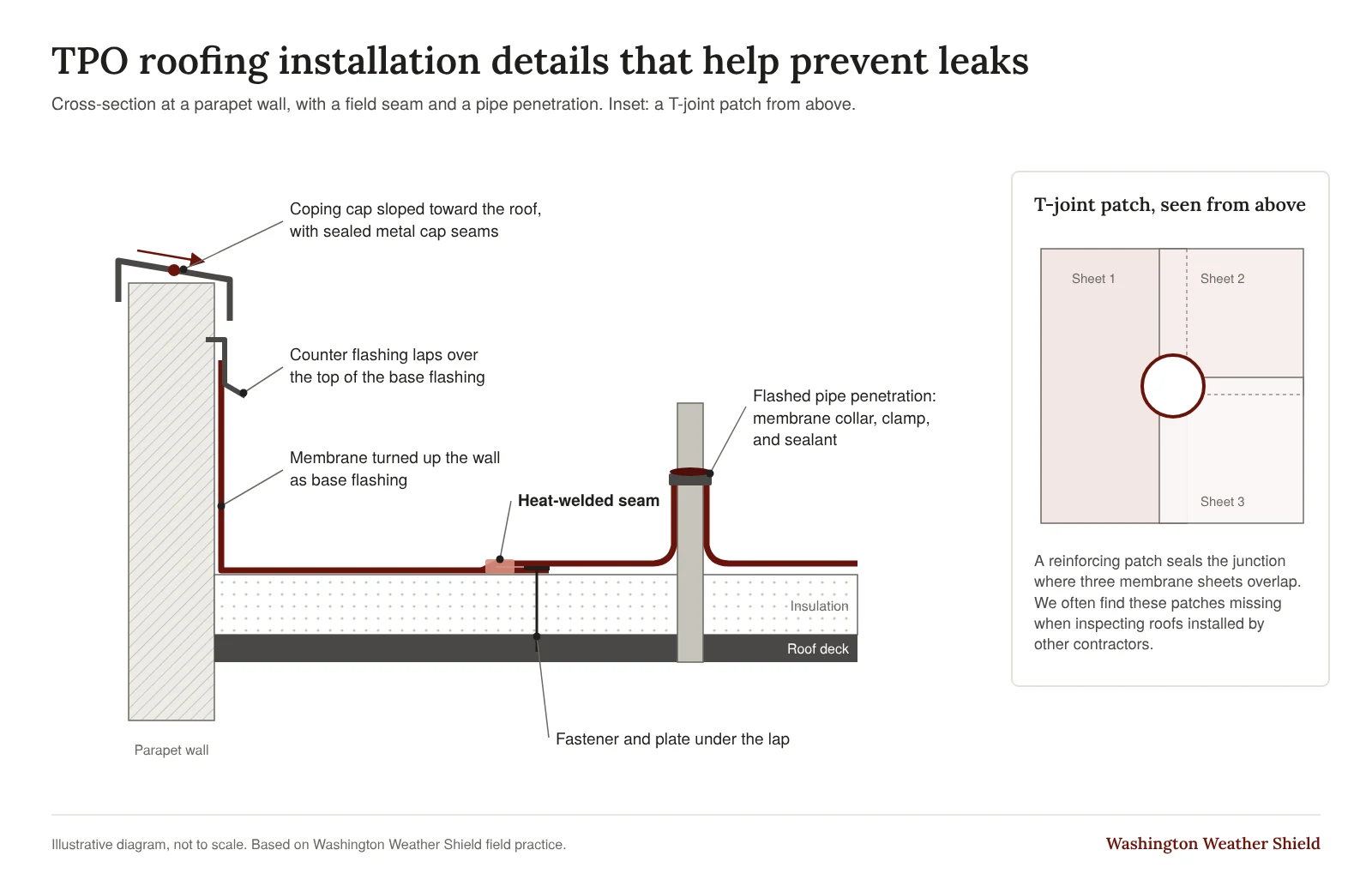
The WSRCA study illustrates why seam workmanship matters. A few seams on two test roofs opened slightly during the first year. Researchers attributed the openings to incomplete welds at installation. After crews rewelded those areas, the seams remained closed during subsequent observations.
“Ultimately, the quality of the installation is just as important as the roofing material itself.”
Rita Prokopets, COO, Washington Weather Shield
Installation during the Puget Sound wet season
TPO must be installed on a clean, dry substrate, within the manufacturer’s installation conditions. Shortcuts in wet weather compromise seam quality and can jeopardize warranty eligibility. We plan around the rainy season weeks ahead and track several forecasts daily once work begins. Crews open only as much roof as they can make watertight the same day, with temporary waterproofing on hand if the weather turns.
Why drainage makes or breaks TPO membrane roofing
A TPO roofing system can only perform as well as the drainage that supports it. On a poorly drained roof, the failure follows the same chain almost every time.
It starts with too little slope, or with drains and scuppers that are undersized, badly placed, or clogged. Water ponds for extended periods and stresses the seams and flashings around it. Once water gets through a weak point, it travels under the membrane and through the insulation before it appears inside. On the leaks we investigate, the source sits somewhere other than where the water shows up about half the time.
Saturated insulation changes the repair, because the wet material has to come out and be replaced. On many buildings we evaluate, ponding from poor slope or drain placement is the real cause of recurring leaks. Fixing the drainage matters as much as replacing the roof.
What maintenance does a TPO roof need in the Pacific Northwest?
Every TPO roofing system needs regular maintenance. On the roofs we maintain, common issues include clogged drains, debris buildup, deteriorating sealant around flashings, and small punctures from foot traffic. Finding these problems early helps prevent leaks and more extensive repairs.
We recommend professional maintenance twice a year: once in late fall, after most leaves have dropped, and again in late winter or early spring. The fall visit focuses on clearing drainage paths before winter storms. The spring visit checks for debris and damage left by the wet months. Roofs near trees may need more frequent drain clearing.
Each visit should include more than cleaning. We inspect the membrane, seams, flashings, and roof edges, then document their condition and any recommended repairs. Between visits, property managers can report visible concerns, such as overflowing drains or loose metal flashing, for professional follow-up.
| What to check | What we look for |
| Drains, scuppers, and downspouts | Blockages, debris, and signs of deterioration that could restrict drainage |
| Membrane surface | Standing water, punctures, foot-traffic damage, debris, and moss |
| Seams and T-joints | Open or lifted seam edges and missing or damaged reinforcing patches |
| Flashings and penetrations | Loose or separated flashing and cracked or missing sealant where required |
| Parapets and coping | Open coping joints, loose metal, and signs of water entry |
| Maintenance records | Dated photos, inspection notes, and repair records to support ongoing care and warranty documentation |
How maintenance protects your warranty
The warranty misconception we hear most often is that a manufacturer warranty covers any leak after installation. In practice, manufacturer warranties typically cover material defects and, where applicable, warrantable installation issues. They generally exclude damage from severe weather, lack of maintenance, clogged drains, and work by other trades on the roof.
Many manufacturer warranties also require documented maintenance, and missing inspection and repair records are the gap that most often puts a claim at risk. Keep a dated file for every visit.
What drives the cost of a TPO roofing system
The cost of a TPO roofing system depends on the work your building needs. Roof size and access, removal of the existing roof, deck repairs, insulation, membrane thickness, and warranty requirements all affect the proposal.
A roof with dry insulation and a sound deck may offer different options than one with trapped moisture or damaged decking. Flashing details, rooftop equipment, and drainage improvements can also add to the scope.
When comparing bids, ask each contractor to explain what is included and what could lead to additional charges. A lower price may reflect a different scope, such as fewer insulation upgrades or omitted drainage work.
One useful question is: “What does your proposal include that another contractor’s might not?” Compare those answers alongside the price to understand what each proposal provides for your building.
Common questions from property owners
What is a TPO roof material?
TPO stands for thermoplastic polyolefin. It is a reinforced, single-ply roofing membrane with heat-welded seams. We install it most often in white on flat and low-slope commercial roofs across Greater Seattle.
What are the disadvantages of TPO roofing?
TPO is not suitable for every roof. Steep slopes require a different roofing approach, and grease or chemical exposure may call for PVC. Membrane quality and thickness also vary, while installation quality affects how well the finished roof performs.
Which is better, TPO or EPDM roofing?
For most low-slope commercial buildings we roof in the Puget Sound region, we recommend TPO. We favor its heat-welded seams over EPDM’s taped or adhered seams. Either way, standing water requires a drainage assessment; membrane choice alone will not fix it.
How long will a TPO roof last?
In our experience, properly installed and maintained TPO roofs provide 20 to 30 years of service in the Puget Sound region. Installation quality, drainage, regular maintenance, and prompt repairs all influence lifespan.
How do you manage TPO roofing installation on an occupied building?
Before work begins, we coordinate access, staging areas, safety zones, and deliveries with the owner or property manager. Our Tenant-First Install Program includes advance notice of noisy work and scheduling around business operations. Clear communication helps owners and tenants plan throughout the project.
The bottom line for Seattle property owners
Before work begins, we coordinate access, staging areas, safety zones, and deliveries with the owner or property manager. Our Tenant-First Install Program includes advance notice of noisy work and scheduling around business operations. Clear communication helps owners and tenants plan throughout the project.
To discuss a TPO roofing system for your building, call 206-594-3509 or request a commercial roofing assessment.
References
- ASTM International. 2026. ASTM D6878/D6878M-26, Standard Specification for Thermoplastic Polyolefin-Based Sheet Roofing. https://store.astm.org/d6878_d6878m-26.html
- Carlson, J., Delgado, A. H., Rosenow, E., Barnhardt, K. C., and Paroli, R. M. 2006. Performance Evaluation of Unexposed and Field-exposed Thermoplastic Polyolefin (TPO) Roof Membranes. Proceedings of the RCI 21st International Convention, via IIBEC. https://iibec.org/publication-post/performance-evaluation-of-unexposed-and-field-exposed-thermoplastic-polyolefin-tpo-roof-membranes/
- Graham, M. S. 2010. Tech Today: Some roofing professionals cite performance issues with TPO membranes. Professional Roofing, NRCA. https://professionalroofing.net/articles/article/1738
- Kehrer, M. 2011. The Effects of Roof Membrane Color on Moisture Accumulation in Low-slope Commercial Roof Systems. NRCA Conference 2011, via Oak Ridge National Laboratory. https://www.ornl.gov/publications/the-effects-of-roof-membrane-color-on-moisture-accumulation-in-low-slope-commercial-roof-systems/
- Levinson, R., and Akbari, H. 2010. Potential Benefits of Cool Roofs on Commercial Buildings. Energy Efficiency, via Lawrence Berkeley National Laboratory. https://eta-publications.lbl.gov/publications/potential-benefits-cool-roofs
- U.S. Energy Information Administration. 2022. 2018 CBECS Table B4: Census Region and Division, Number of Buildings. https://www.eia.gov/consumption/commercial/data/2018/bc/pdf/b4.pdf
- U.S. Energy Information Administration. 2022. 2018 CBECS Table B9: Year Constructed, Floorspace. https://www.eia.gov/consumption/commercial/data/2018/bc/pdf/b9.pdf