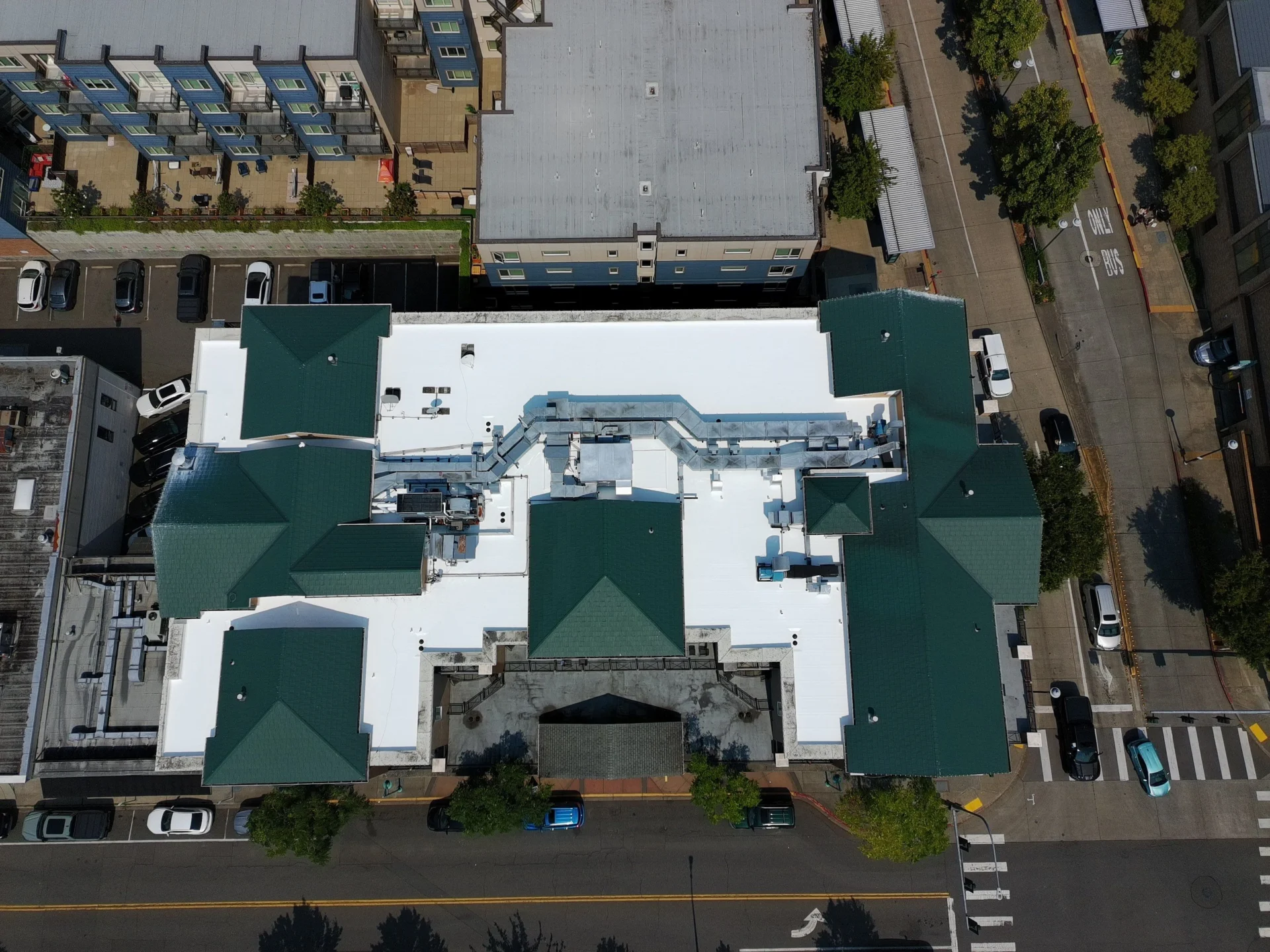
A replacement quote lands on your desk, and the number alone makes you want a second opinion. That’s often when commercial roof restoration enters the conversation. Restoration repairs and restores an existing roof system rather than tearing it off and replacing it.
For the right roof, restoration can extend service life and provide a more cost-effective alternative to replacement. But not every roof is a good candidate. The decision depends on the condition of the existing roof, including the membrane, insulation, substrate, drainage, and extent of any moisture or deterioration.
Key takeaways
- Restoration repairs and coats a serviceable roof rather than replacing the entire system.
- Candidacy depends on the roof’s overall condition, including moisture, insulation, membrane, and substrate.
- Coating over wet or damaged materials can conceal the problem rather than solve it.
- In the Seattle area, coating work is typically scheduled from late spring through summer when weather conditions allow.
What roofing restoration actually involves
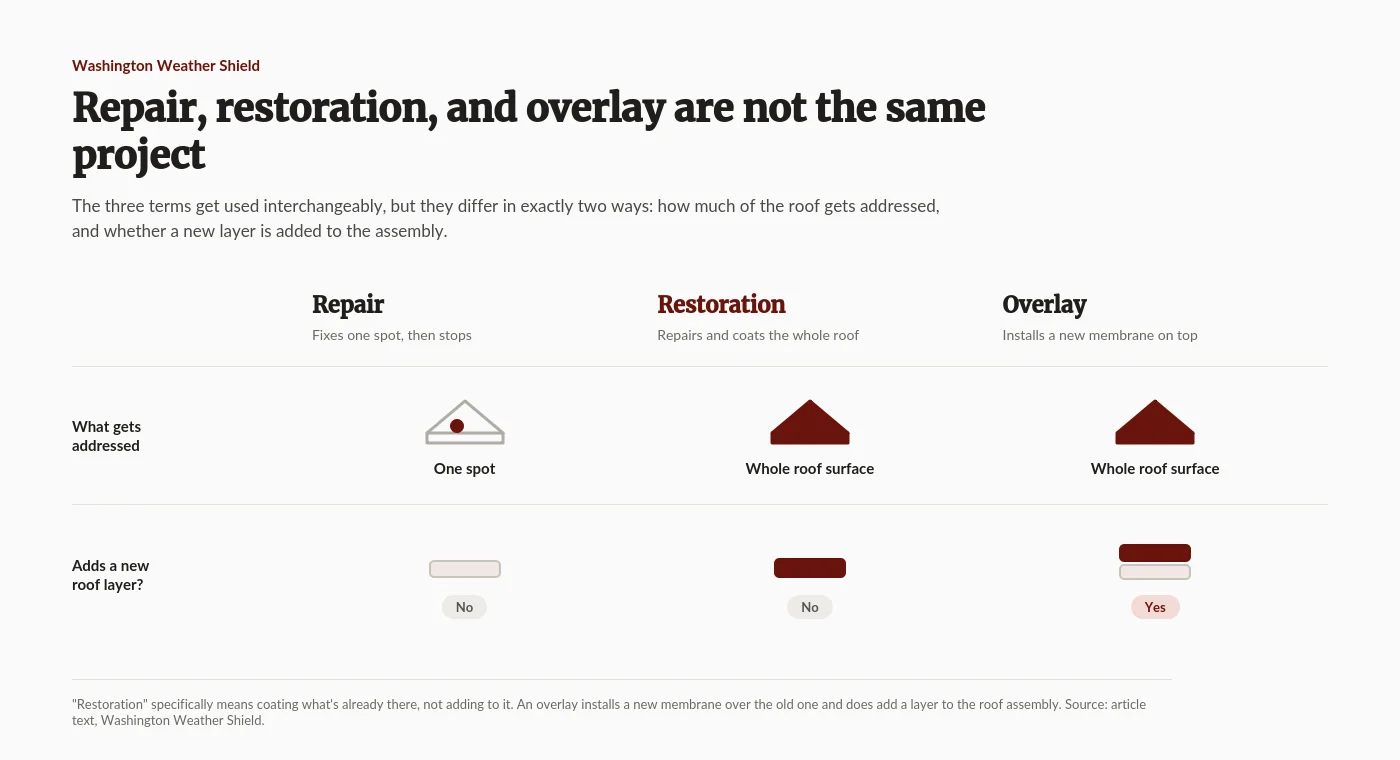
Roofing restoration involves repairing defects across the existing roof, then applying a fluid-applied coating system over the prepared surface. Unlike a localized repair, restoration addresses the roof more broadly. It also differs from an overlay, which installs a new roofing membrane over the existing system.
For commercial low-slope and metal roofs, every restoration project should start with one question: Is the existing roof still a sound foundation for restoration?
Is your roof a restoration candidate?
Not every commercial roofing restoration project is the right fit for every building, and the eligibility question comes before the coating question.
What makes a roof a good candidate
A good candidate is dry underneath, structurally sound, and mostly serviceable. The membrane can be worn or faded, but it can’t be saturated.
We treat the roof as one system rather than checking a single number. The Army Corps of Engineers’ ROOFER inspection system works the same way. It scores each roof section on its own 0 to 100 Condition Index rather than the roof as a whole.
“We also consider whether the expected life gained from the restoration justifies the investment versus putting that money toward a new roof.”
Rita Prokopets, COO, Washington Weather Shield
What rules restoration out
Restoration is off the table when wet insulation covers a large area, or when the membrane or seams and flashings are failing broadly across the roof. Coating over saturated insulation doesn’t dry it out. It seals the moisture in while the roof keeps degrading beneath a surface that looks fine. A prior coating failure, a structural deck problem, or a repeatedly failing repair spot all point toward replacement too.
Ponding deserves a closer read than a flat yes or no. NRCA recommends sloping coating systems for positive drainage. It also notes that a tapered cricket naturally creates a shallower valley slope, so some ponding there is expected.
After a storm, sequence matters. A storm damage roof restoration project and a wind damage roof restoration project both start the same way: diagnose, repair, then decide whether the roof can take a coating. Coating over unresolved damage just buries it. Fresh storm damage and long-term wear also call for different repair scopes and, often, different insurance documentation.
Restoration eligibility checklist
- Roof assembly is generally dry, with no significant trapped moisture
- Membrane is weathered but still in serviceable condition
- Seams, flashings, and penetrations can be properly repaired
- No widespread soft spots, sagging, or deteriorated decking
- Existing coatings, if present, are evaluated for condition and compatibility
- Any storm damage or recurring leaks are identified and addressed before coating
Why moisture testing comes before any coating decision
A visual inspection tells you a lot about the roof surface, but it may not reveal moisture trapped in the insulation below.
Infrared scanning can help identify areas where wet insulation may be present beneath the membrane. The scan is performed at night under appropriate conditions, as outlined in ASTM C1153. It can locate potential wet areas, but it does not identify where the moisture entered.
These findings are typically verified through physical testing, such as core samples. The testing method also has to match the roof system. For example, electrical impedance scanning, covered under ASTM D7954, is not appropriate for black EPDM or electrically conductive surfaces such as metal roofing.
Together, these findings provide a clearer picture of whether the existing roof is a good candidate for restoration.
Choosing a coating system for a Puget Sound roof
The three main coating options are silicone, acrylic, and polyurethane. Each responds differently to standing water, UV exposure, and foot traffic. In the Puget Sound climate, silicone is often the strongest fit because it performs well under ponding water and repeated wet conditions.
Acrylic is typically more budget-friendly but is less suited to prolonged standing water. Polyurethane offers stronger resistance to foot traffic and mechanical wear, making it useful on roofs with regular rooftop activity.
We most often install GE Enduris silicone coatings on TPO, PVC, metal, and torch-down roofs. But product compatibility alone isn’t enough. The roof still needs to be evaluated for moisture, overall condition, and adhesion before a coating system is selected.
“We always perform adhesion test patches before committing to a coating system because compatibility alone doesn’t guarantee the coating will bond properly to that particular roof.”
Rita Prokopets, COO, Washington Weather Shield
Code requirements can also vary by roof system and coating type, so the product needs to meet the applicable standards for that specific application. That’s one more reason coating selection should come after a full roof assessment, not before it.
Coating system comparison
| System | Ponding water | UV resistance | Common substrates | Best suited to |
|---|---|---|---|---|
| Silicone | Strong | Strong | TPO, PVC, metal, torch-down | Low-slope roofs, wet climates, ponding-prone areas |
| Acrylic | Limited with prolonged ponding | Strong | Metal, single-ply, asphaltic roofs | Roofs with positive drainage |
| Polyurethane | Varies by system | Varies by product | Varies by product | High-traffic or higher-wear applications |
What a restoration project looks like on an occupied building
A commercial roof restoration follows a set sequence:
- Roof assessment and moisture testing
- Core verification and adhesion testing
- Cleaning and surface preparation
- Repairs at seams, flashings, and penetrations
- Coating application and curing
- Final inspection and warranty documentation
Most repair work concentrates on the details: seams, penetrations, and transitions.
Seattle’s short coating season
“Realistically, our coating season in the Seattle area is fairly short, typically late spring through summer and sometimes into early September.”
Rita Prokopets, COO, Washington Weather Shield
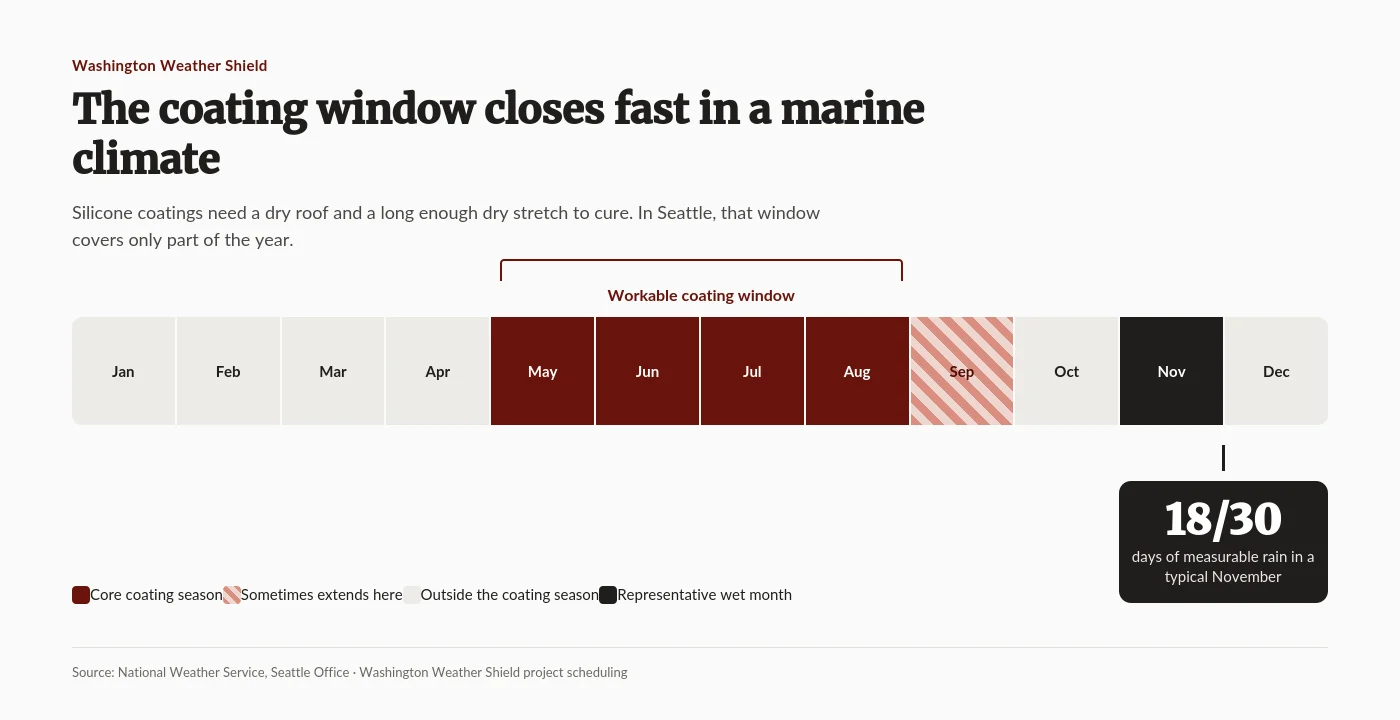
The roof needs to be dry, the temperature has to be in range, and the dry window has to be long enough to cure. Overnight temperature, dew point, and morning condensation all factor in, not just the daytime forecast. Rain before a coating cures can wash it out or damage adhesion, which is why scheduling stays conservative whenever rain shows up in the forecast.
Weather constrains the assessment stage too. ROOFER’s inspection manual tells inspectors to postpone a metal roof inspection outright if snow, frost, or visible moisture is present. November shows why the window matters. Seattle sees measurable rain on 18 of the month’s 30 days on average, and a roof that misses its summer window waits until next year.
Keeping the building running
Restoration disrupts less for a structural reason, not a marketing one. No tear-off means no open deck, no debris chutes, and a shorter schedule. An industrial roof restoration on an active warehouse looks different from a retail project with customers below, but the coordination is the same.
Plan access and staging ahead, protect rooftop equipment, mark safety zones, and give occupants notice before noisy work starts. On a multi-family job, that can mean routing every roll of material through a shared elevator rather than disrupting residents’ entrances. The same planning applies to offices, schools, healthcare campuses, and industrial buildings that need to keep running.
Commercial metal roof restoration
A metal roof can be a good restoration candidate if the panels are still structurally sound. Before any coating goes down, we address the areas most likely to fail first:
- Loose or failing fasteners
- Rusted or corroded metal
- Open seams and failing sealants
- Penetrations and flashing
- Debris that can trap moisture around vulnerable areas
The coating comes last. It should protect a roof that has already been repaired, not cover over unresolved problems.
The condition of the metal itself is what usually draws the line between restoration and replacement. Surface wear such as chalking, fading, or minor scratching can often be treated, while widespread base-metal corrosion points toward replacement. Fastener problems matter too, especially when they are loose, missing, or already allowing water into the system.
Roof restoration vs replacement: how the decision actually breaks
One practical advantage of restoration is that it works with the existing roof rather than adding another roofing system on top of it. An overlay adds a physical layer, while restoration repairs and coats what is already there. That can preserve more flexibility for future roofing work.
Cost and disruption
Replacement carries tear-off labor, disposal, and often deck or insulation repair. Restoration costs depend more heavily on the amount of repair needed before the coating goes down.
Avoiding a tear-off also means generating less waste. The EPA estimated 600 million tons of construction and demolition debris in the United States in 2018, with nearly 144 million tons sent to landfills.
When restoration makes financial sense
We recently completed a silicone restoration on a Seattle commercial roof that was still serviceable and a strong candidate. The owner saved approximately 30% compared with a full replacement, while extending the useful life of the existing roof.
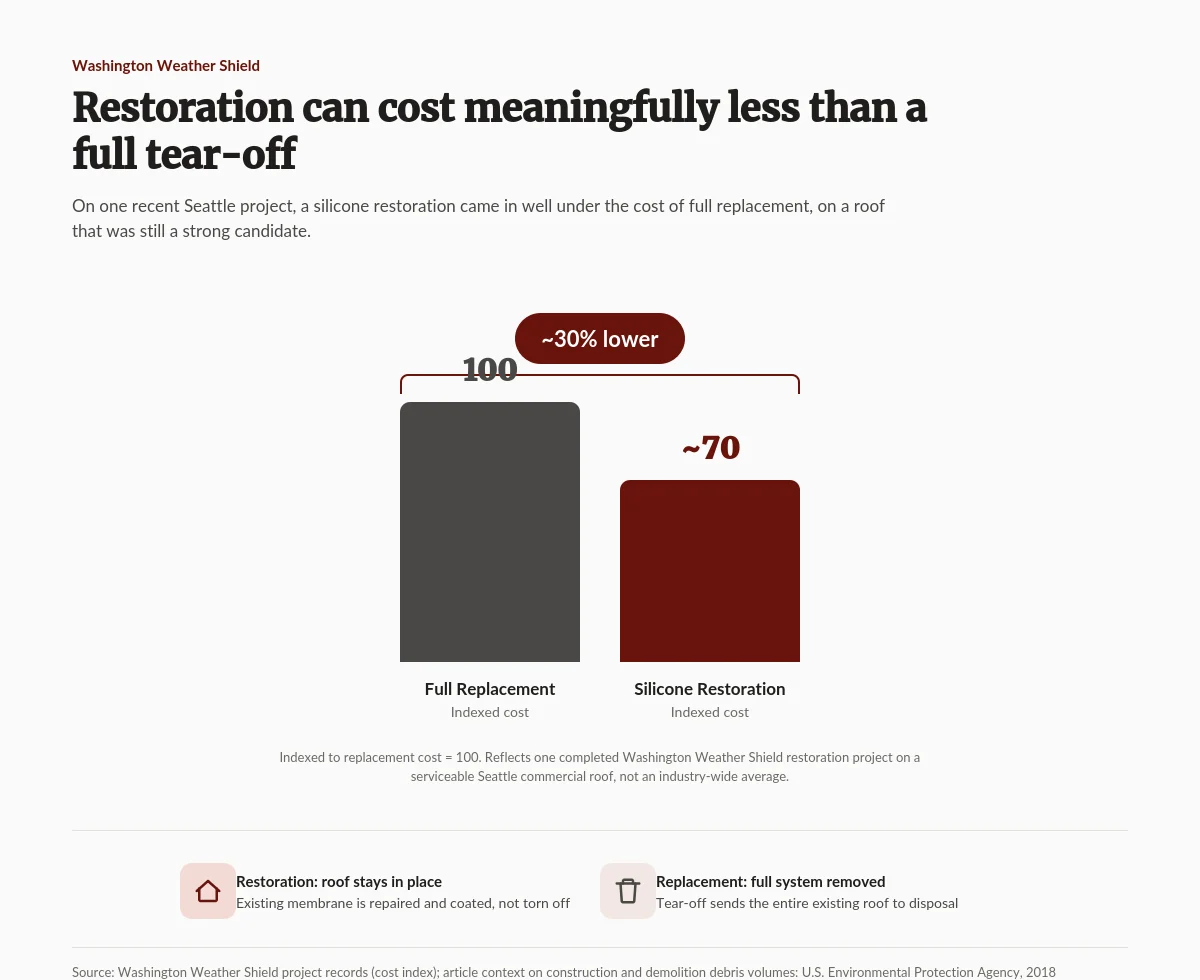
But those savings only matter when the roof qualifies. If moisture, widespread deterioration, or structural issues rule restoration out, a commercial roof replacement becomes the better long-term path.
Roof restoration vs replacement
| Factor | Restoration | Replacement |
|---|---|---|
| What drives cost | Repair scope, roof size, substrate condition | Tear-off, disposal, insulation and deck work |
| Disruption | Typically lower; existing roof remains | Typically higher; more extensive removal and installation |
| Waste generated | Less; existing roof largely stays in place | More; existing materials may be removed |
| Warranty type | Coating system warranty | Manufacturer system warranty, including NDL options |
| Assessment required | Moisture, condition and adhesion testing | Overall roof and substrate condition |
What a restoration warranty actually covers
Not all commercial roofing restorations carry the same warranty terms. A restoration warranty generally covers the coating system according to the manufacturer’s specific terms. A new TPO or PVC system, by comparison, may qualify for a manufacturer NDL warranty covering labor and materials for covered issues. Comparing the two on warranty length alone doesn’t tell the whole story.
One advantage of a silicone restoration system is that, if the roof remains a good candidate, it can potentially be cleaned, prepared, and recoated in the future to extend its service life again.
“Restoration is about extending the life of a serviceable existing roof, not replacing the underlying roof system.”
Rita Prokopets, COO, Washington Weather Shield
Warranty requirements vary by manufacturer and system, so building owners should understand the required inspections, maintenance, documentation, and exclusions that apply to their specific warranty.
Commercial Roof Restoration FAQs
What is commercial roof restoration?
Commercial roof restoration repairs and prepares an existing low-slope or metal roof, then applies a fluid-applied coating system. It can extend the roof’s service life without a full tear-off when existing conditions are suitable for restoration.
What is the roof restoration process?
The process typically includes assessment, moisture testing, core verification, adhesion testing, cleaning and preparation, repairs, coating application, curing, final inspection, and warranty documentation.
What is the life expectancy of a commercial roof?
Service life varies by roofing system, installation, exposure, and maintenance history. Age is one factor when evaluating a roof for restoration, but its current condition and moisture levels are more important in determining whether it is a good candidate.
How much does it cost to restore a commercial roof?
Cost depends on roof size, existing system, condition, repair requirements, and access. Restoration can avoid many of the tear-off and disposal costs associated with replacement, but an accurate price requires a site-specific assessment.
Is restoration right for your roof?
Before anything else, you need to know whether the roof is actually worth restoring. The first step is finding out what condition it’s in and whether restoration is still a viable option.
Request a roof assessment from Washington Weather Shield.
Reference list
- U.S. Army Engineer Research and Development Center, Construction Engineering Research Laboratory (2012). ROOFER Inventory Procedures and Inspection Manual for Metal Panel Roofing, ERDC TR-12-15. https://apps.dtic.mil/sti/pdfs/ADA582971.pdf
- Graham, M.S. (2018). “Roof slope guidelines.” Professional Roofing, National Roofing Contractors Association. https://www.professionalroofing.net/Articles/Roof-slope-guidelines–08-01-2018/4284
- ASTM International (2023). C1153-23, Standard Practice for Location of Wet Insulation in Roofing Systems Using Infrared Imaging. https://www.astm.org/Standards/C1153.htm
- ASTM International (2021). D7954/D7954M-15a(2021), Standard Guide for Moisture Surveying of Roofing and Waterproofing Systems Using Non-Destructive Electrical Impedance Scanners. https://store.astm.org/d7954_d7954m-15ar21.html
- ASTM International (2021). D6083-21, Standard Specification for Liquid Applied Acrylic Coating Used in Roofing. https://store.astm.org/d6083_d6083m-21.html
- Graham, M.S. (2019). “Coating concerns: Building code compliance for roof coatings is limited.” Professional Roofing, National Roofing Contractors Association, March 2019. https://nrca.net/roofingguidelines/pdf?id=175908&k=1785886
- National Weather Service, Seattle Office. “Seattle’s Wettest Month and Record Flooding in Western Washington, November 2006.” https://www.weather.gov/media/sew/events_page/Nov%202006%20wettest%20month.pdf
- U.S. Environmental Protection Agency (2018). “Construction and Demolition Debris: Material-Specific Data.” https://www.epa.gov/facts-and-figures-about-materials-waste-and-recycling/construction-and-demolition-debris-material
- Washington Weather Shield — Commercial Roof Replacement. https://waweathershield.com/commercial-roof-replacement/