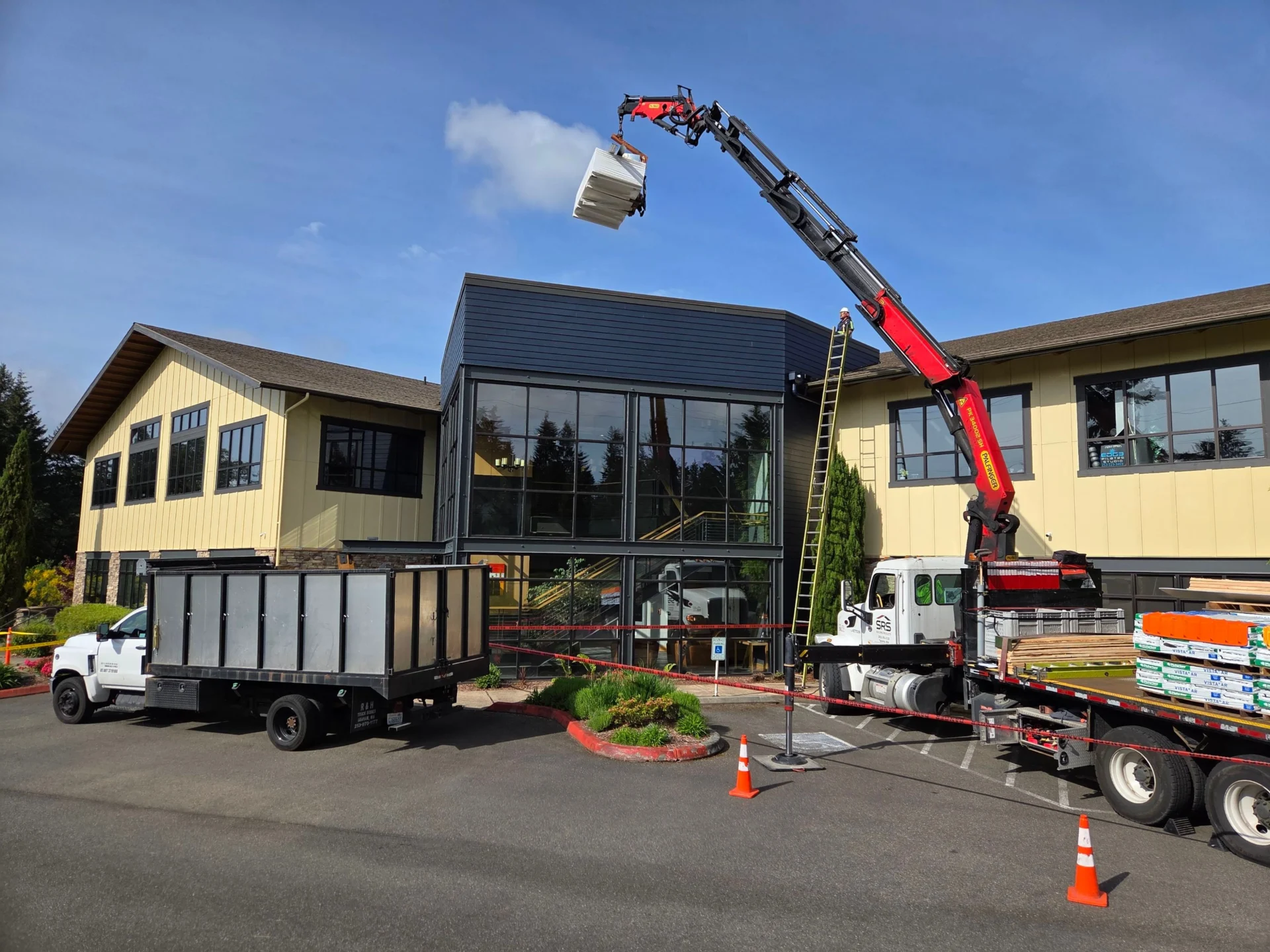
Your building cannot shut down for three weeks while the roof comes off. Tenants still need the elevators, the loading dock, and a ceiling that stays dry through a Tuesday downpour. That single constraint shapes every decision on a new roof installation for a commercial property in the Greater Seattle Area. It drives the system you specify, the sequence the crew works in, and the hour they start making noise.
The new roof installation process moves through three phases: planning and assessment before mobilization, the active work overhead, then closeout with inspection and warranty activation. Here is what happens in each phase, and what a wet marine climate changes about all three.
Key takeaways
- Typical project duration runs anywhere from three days to four weeks, driven mostly by roof size, building access, and the condition of the deck under the old system.
- Three variables move a commercial schedule: hidden deck damage, a shifting forecast, and rooftop equipment that does not match the drawings.
- TPO is the system Washington Weather Shield specifies most often on low-slope buildings here, on the strength of its heat-welded seams and warranty terms.
- Occupied buildings stay open throughout the work. That depends on planning, not luck.
- At closeout, you should hold warranty documentation, permit sign-off, and the maintenance schedule that keeps your coverage valid.
Table of contents
1. How long will your building be under construction?
2. What happens before the crew arrives
3. Choosing the right roofing system for a Puget Sound building
4. What an active new roof install looks like day to day
5. The flashing details that decide whether the roof leaks
6. How new roof construction changes by building type
7. What you should get when the job is done
8. Frequently asked questions
How long will your building be under construction?
Most commercial replacement projects in the Puget Sound region take anywhere from three days to four weeks once installation begins. Roof size, building access, weather, and the condition of the existing assembly can move that timeframe in either direction.
Duration and disruption are separate questions, and building owners routinely collapse the two into one. A three-week project does not mean three weeks of disruption for every tenant in the building, because crews work one section at a time. The affected area moves across the roof as the job progresses, and most tenants notice it for a fraction of the schedule.
Three variables genuinely change a schedule once work begins. Hidden roof deck deterioration is the first, and it only reveals itself after the old system comes off. The second is a forecast that turns faster than the crew can close the area they have already opened. The third is rooftop equipment sitting somewhere other than where the original drawings indicate.
Everything else on a well-run project gets settled before anyone climbs a ladder. Material deliveries, staging areas, crew size, and the daily work sequence are all fixed during planning. Getting a new roof on an occupied building is largely a scheduling exercise, and the schedule holds when those three variables are planned for rather than discovered. Ask the new roof contractors you are evaluating how they absorb each one. The answer tells you more than a bid total does.
What happens before the crew arrives
The pre-installation assessment
A thorough assessment helps uncover costly surprises before a **new roof installation** begins. On commercial buildings across the nine-county service area, the most common issues are hidden deck deterioration, ponding caused by poor drainage, and cracks or tears in the existing roofing.
These problems are easy to miss during a visual walkthrough. A moisture survey and core samples can reveal saturated insulation and other concealed damage, allowing the contractor to define the scope before work starts instead of adding costly change orders later.
The findings also help determine whether the existing roof should be removed or recovered. When the existing roofing system is dry, securely attached, and suitable for an overlay – and local code permits it – a roof recover is often the preferred approach because it minimizes disruption, reduces waste, and lowers costs. A full tear-off is recommended when required by code, when the existing roof is unsuitable for an overlay, or when specifically requested by the building owner.
Permits, planning, and the rain calendar
Planning around the wet season starts weeks ahead of mobilization, but the weather work happens every day of the project. Crews track multiple forecasts and schedule the heaviest work into the favorable windows those forecasts open up. They keep temporary waterproofing staged on site and limit the amount of roof left open at any one time.
“In our climate, proactive weather planning is one of the biggest factors in a successful commercial roofing project.”
Rita Prokopets, COO, Washington Weather Shield
Permit work runs alongside the weather calendar, and wind load is part of that package. The National Roofing Contractors Association publishes a free Roof Wind Designer tool that determines a building’s design wind load for code compliance before installing a new roof. The same association maintains the four-volume NRCA Roofing Manual, the industry reference for design and installation across nearly every commercial system type.
Choosing the right roofing system for a Puget Sound building
| System | Seam method | Ponding tolerance | Rooftop penetrations | Where it fits here |
| TPO | Heat-welded | Strong with correct slope and drainage | Welded flashing at curbs and pipes | Default choice for most low-slope commercial roofs |
| PVC | Heat-welded | Strong with correct slope and drainage | Welded flashing; resists grease and chemical exposure | Restaurants, food processing, kitchen exhaust nearby |
| Metal | Mechanically seamed | Poor on flat areas; needs positive slope | Every penetration needs deliberate detailing | Steeper-slope sections and architectural elements |
| Modified bitumen | Torch-applied or self-adhered | Multi-ply build gives redundancy | Detailing is labor-intensive | Roofs with heavy foot traffic or complex geometry |
| EPDM | Adhesive and tape | Adequate, with seams as the watch point | Adhered flashing at penetrations | Simple roof planes carrying few penetrations |
Nearly every commercial building in the Puget Sound region has a low-slope roof, defined by ENERGY STAR as a pitch of 2:12 or less. Because water drains more slowly, drainage design and seam quality are critical during a new roof installation. Ponding that remains for days after rainfall should be corrected before the new system is installed.
Washington Weather Shield recommends TPO for most low-slope commercial buildings in the region. Its heat-welded seams create a continuous surface, while its warranty terms and cost-to-performance balance make it a strong option for many properties. The final recommendation still depends on the roof’s drainage, ponding history, and rooftop equipment.
Local conditions that influence the system choice
Two Puget Sound conditions deserve particular attention:
- Tree coverage: Moss, cedar needles, and other debris can block drains and hold moisture against the membrane.
- Rooftop equipment: HVAC curbs, exhaust fans, and conduit increase the amount of flashing required, often favoring systems with heat-welded penetration details.
A building may not need a new roof yet if the existing structure and membrane are still sound. In that case, a roof coating may extend its service life at a lower cost than new roofing, although coatings must be applied during warm, dry weather to cure properly.
Reflective roofing also provides less energy savings here than it does in hot, sunny climates. Cooling benefits in Puget Sound are typically modest, but lower roof temperatures may still help extend the life of the roofing materials.
What an active new roof install looks like day to day
Tear-off, phasing, and the daily closeout
One rule governs everything that happens during a Pacific Northwest tear-off. Never open more roof than the crew can close before the end of the day.
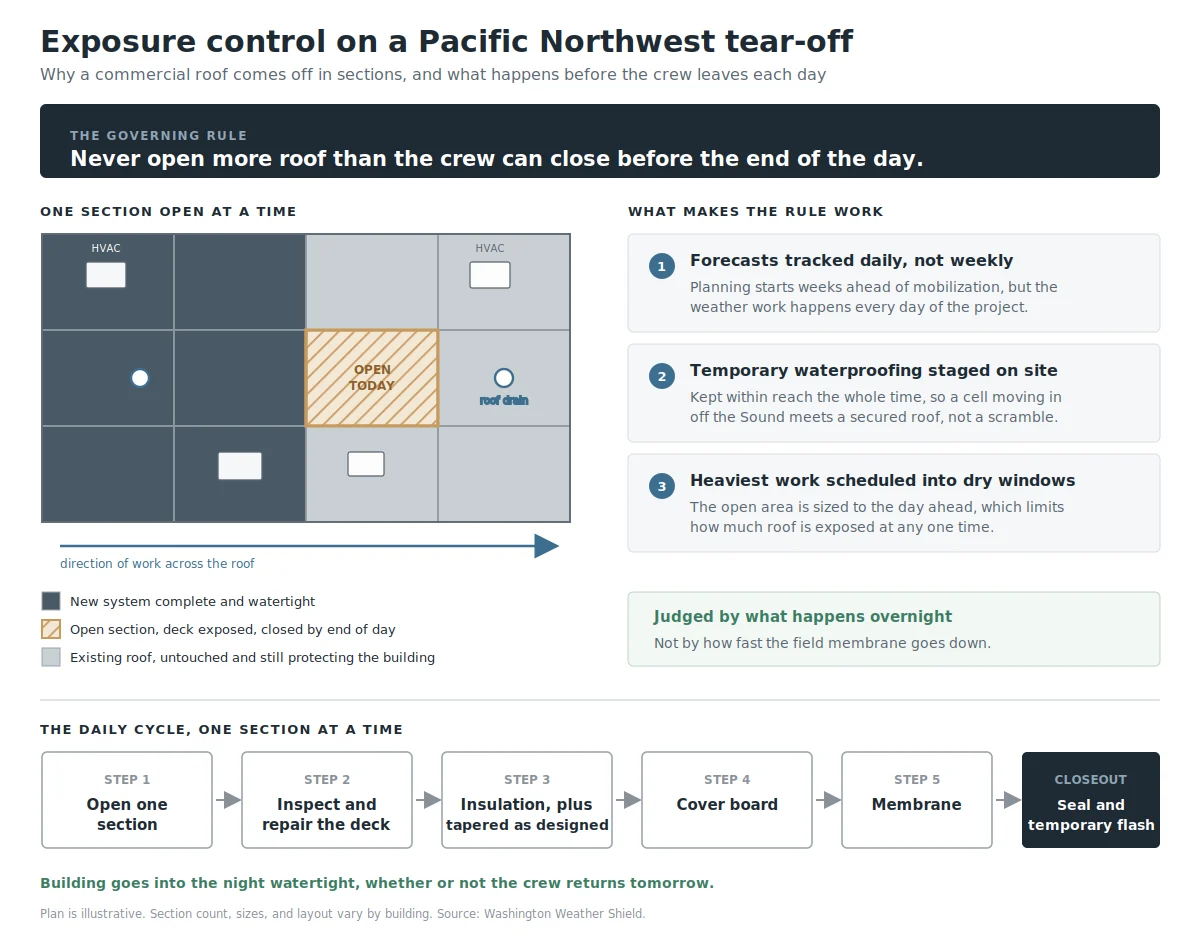
That rule is why a commercial tear-off proceeds in sections rather than stripping the whole field at once. A section comes off, then the deck gets inspected and repaired where the assessment or the tear-off itself found damage. Insulation goes down next, followed by cover board and the membrane, with tapered insulation set where the drainage design calls for added slope. Temporary waterproofing remains readily available throughout the project, allowing crews to quickly secure exposed areas if unexpected weather moves in.
Daily closeout is the part tenants never see, and it is the part they benefit from most. The open area gets sealed and penetrations get temporary flashing, so the building goes into the night watertight. New roofing installation on an occupied property is judged by what happens overnight, not by how fast the field membrane goes down.
Access, noise, and safety zones
Planning happens before the crew mobilizes. For each new roof installation, Washington Weather Shield coordinates the following with the owner, property manager, or maintenance team:
- Site access and delivery schedules
- Material staging and restricted safety zones
- Protection of rooftop HVAC equipment
- Advance notice of noisy work
Safety planning is especially important. OSHA standard 29 CFR 1926.501 requires guardrails, safety nets, or personal fall-arrest systems whenever work takes place six feet or more above a lower level. In 2016, falls caused 38.7% of 991 construction worker deaths, showing why fall protection is central to every commercial roofing site plan.
Crew experience also matters when comparing new roof contractors. The Bureau of Labor Statistics identifies balance, comfort working at heights, and attention to detail as essential roofing skills. It also projects roofer employment to grow 6% from 2024 to 2034, making ongoing training and quality control increasingly important.
Tear-off is typically the loudest stage of installing a new roof. Giving tenants advance notice helps them plan around the disruption and reduces avoidable complaints.
The flashing details that decide whether the roof leaks
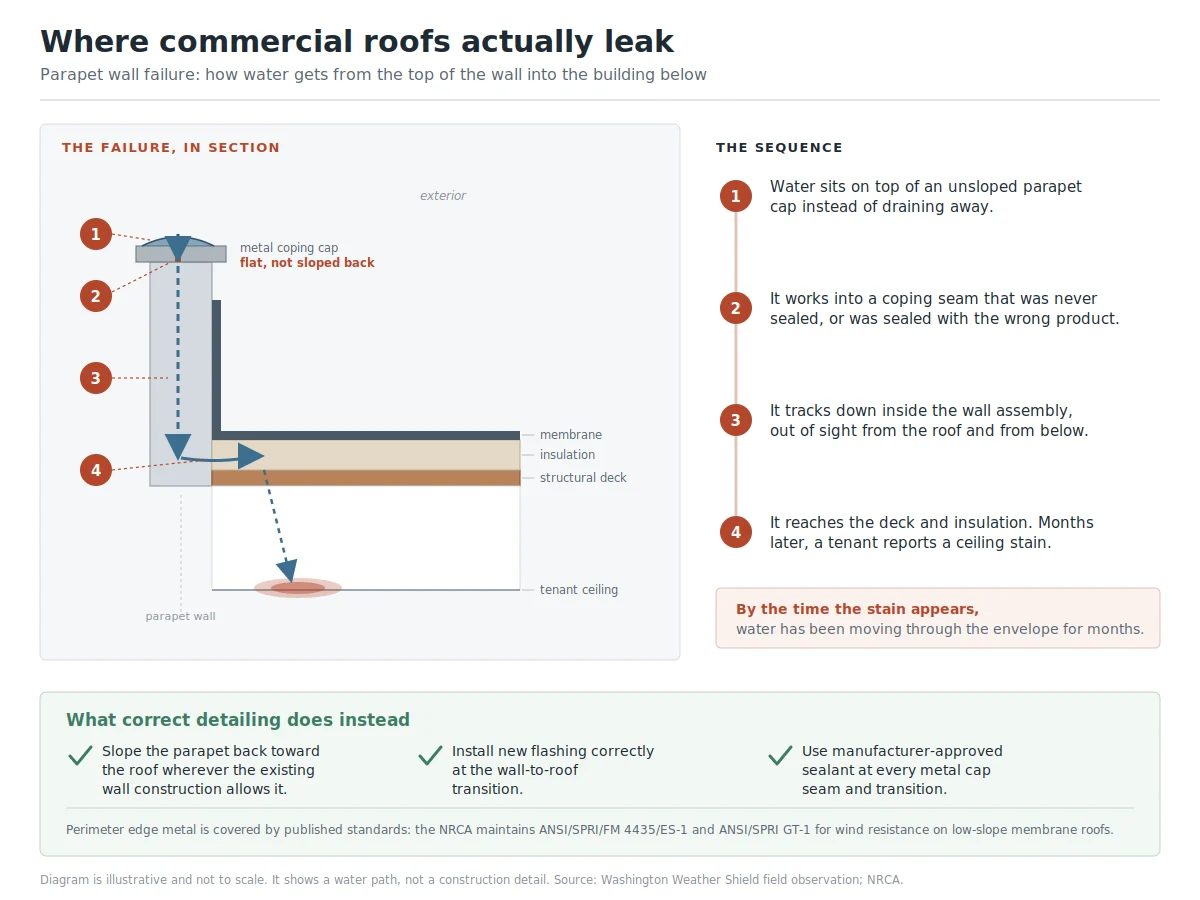
Parapet walls are a common leak point on commercial roofs, and the problem is usually in the detailing rather than the membrane. During inspections, Washington Weather Shield often finds the same issues on older systems or roofs where key installation details were missed:
- Unsealed coping cap seams
- Sealants that are not approved for the system
- Parapet walls that do not slope back toward the roof
Water can collect on a flat parapet, enter through an open seam, and travel through the wall assembly into the deck and insulation. By the time a tenant notices a ceiling stain, the leak may have been developing for months.
Why perimeter detailing matters
During a new roof installation, parapets should be sloped toward the roof wherever the existing construction allows. New flashing must be installed correctly, with manufacturer-approved sealants at every metal cap seam and transition.
The edge metal system must also meet established wind-resistance requirements. ANSI/SPRI/FM 4435/ES-1 and ANSI/SPRI GT-1 set the relevant standards for low-slope membrane roofs.
The Insurance Institute for Business and Home Safety also updated its FORTIFIED Commercial standard in 2025. Roof-mounted vents must now pass testing showing that they can “block wind-driven rain intrusion.” In the Puget Sound region, this level of detailing is an important part of installing a durable new roof.
How new roof construction changes by building type
With new commercial roof construction, the roofing work itself is broadly similar from one property type to the next. What changes is everything happening below the deck.
| Building type | Primary constraint | What changes on site |
| Office and multi-tenant | Business hours and tenant notice | Phased access, advance notice before loud work |
| Retail | Customer entrances and deliveries | Staging clear of public routes, early-morning work |
| Schools | Term calendar and student safety | Hard separation from occupied areas, break-period scheduling |
| Hospitals and medical | Continuous operation, sensitive areas | Noise limits, coordination with facilities and infection control |
| Warehouse and industrial | Racking and forklift traffic below | Interior protection, dock and delivery coordination |
| Hospitality | Guest experience | Near-invisible crew presence, off-hours staging |
Occupied buildings need a level of planning that a vacant warehouse does not. Work gets scheduled around business hours, tenant access, deliveries, and any areas the facility team flags as sensitive. The site has to stay safe for everyone using the building while all of that happens.
Multi-tenant properties raise the communication load, because notice has to reach people who never signed the contract. Advance warning of loud work, temporary access restrictions, and material deliveries lets occupants plan their own week around yours. Facility teams field the questions tenants ask, so they need the schedule before the tenants get it.
“Proactive communication is just as important as the roofing work itself.”
Rita Prokopets, COO, Washington Weather Shield
Washington Weather Shield has successfully completed reroof projects on large, occupied hospitality properties where maintaining a positive guest experience was a top priority. Through careful planning, clear communication, and well-coordinated operations, hotel staff were able to continue serving guests throughout construction with minimal disruption. Several clients have even commented that they barely noticed our crews working overhead.
What you should get when the job is done
A commercial new roof installation closes with three separate inspections:
- Contractor inspection: A thorough final inspection by the installing contractor to verify the roof has been completed in accordance with the project scope and quality standards.
- Manufacturer inspection: An onsite inspection performed by the manufacturer’s field representative to verify the roofing system was installed in accordance with the manufacturer’s specifications before the warranty is issued.
- Permit inspection: A final inspection by the local jurisdiction, when required, to close out the building permit.
Warranty options also depend on the contractor’s certification level. Manufacturers reserve their strongest system warranties for highly certified contractors who have demonstrated a proven track record of quality installations and ongoing training. Washington Weather Shield is proud to hold GAF GoldElite Commercial Contractor status, allowing us to offer GAF’s highest levels of commercial warranty protection. Before hiring a roofing contractor, confirm which manufacturer certifications they hold and which warranty options they are authorized to provide.
Your final closeout package
At the end of the new roof installation process, you should receive:
- Executed manufacturer warranty documentation
- Permit sign-off
- A maintenance and inspection schedule
Most manufacturer warranties require documented periodic inspections. Following that schedule helps keep the coverage valid throughout the life of your new roof.
Frequently asked questions
How to tell if you need a new roof?
Recurring leaks in different locations, ponding water that lingers for days after rain, and widespread cracking across the membrane field are all signs that a roof may be approaching the end of its service life and could warrant replacement rather than repair. Soft spots underfoot often indicate the insulation beneath the membrane has become saturated, which may also lead to deterioration of the underlying roof deck if left unaddressed. A professional roof assessment, including a moisture survey, is the best way to determine whether a targeted repair is appropriate or if a full roof replacement is the more cost-effective long-term solution.
How long does a new roof last?
A commercial new roof typically lasts 15 to 30 years, depending on the roofing system, installation quality, drainage, weather exposure, and ongoing maintenance. Metal roofing can often last 40 to 60 years or longer. A heat-welded single-ply membrane installed over a well-drained deck will generally outlast the same system exposed to standing water. Manufacturer warranty terms provide a useful planning baseline, although warranty length is not necessarily the same as expected service life.
Can I get a new roof in winter?
Yes, with adjustments to how the work is sequenced. Single-ply membrane work continues through Puget Sound winters as long as the crew tightens exposure control and shortens the open sections. Fluid-applied coatings are the exception, since they need warm, dry conditions to cure and realistically belong in the drier months.
How often do you need a new roof?
With proper care and maintenance, commercial roofs can last longer than many building owners expect. Regular inspections, routine drain cleaning, and timely repairs can help a roofing system reach its expected service life, while neglected roofs are more likely to experience premature deterioration and costly problems.
Planning a new roof installation for your building
The projects that go quietly are the ones planned before anyone climbs a ladder. Deck condition is understood before mobilization, the schedule accounts for the weather, and tenants know what is coming and when. The closeout package is defined in the scope rather than assembled after the fact.
Book a free roof inspection with Washington Weather Shield and receive a detailed roof assessment, moisture recommendations (when applicable), and a written scope of work tailored to your building. Call 206-504-1500 or email info@waweathershield.com.
References
- Bureau of Labor Statistics, U.S. Department of Labor. Occupational Outlook Handbook: Roofers. https://www.bls.gov/ooh/construction-and-extraction/roofers.htm
- ENERGY STAR (U.S. EPA / U.S. DOE). Cool Roofs Help Reduce Energy Costs. https://www.energystar.gov/products/ask-the-experts/cool-roofs-help-reduce-energy-costs
- ENERGY STAR (U.S. EPA / U.S. DOE). Cool Roofs. https://www.energystar.gov/products/cool-roofs
- Insurance Institute for Business & Home Safety. IBHS Releases Updated Resilient Construction Standards. https://ibhs.org/ibhs-news-releases/ibhs-releases-updated-resilient-construction-standards/
- National Roofing Contractors Association. Roofing Guidelines. https://www.nrca.net/roofing-guidelines
- Occupational Safety and Health Administration, U.S. Department of Labor. Fall Protection in Construction (29 CFR 1926.501). https://www.osha.gov/fall-protection/construction
- Occupational Safety and Health Administration, U.S. Department of Labor. Protecting Roofing Workers (OSHA Publication 3755). https://www.osha.gov/sites/default/files/publications/OSHA3755.pdf
About the author