

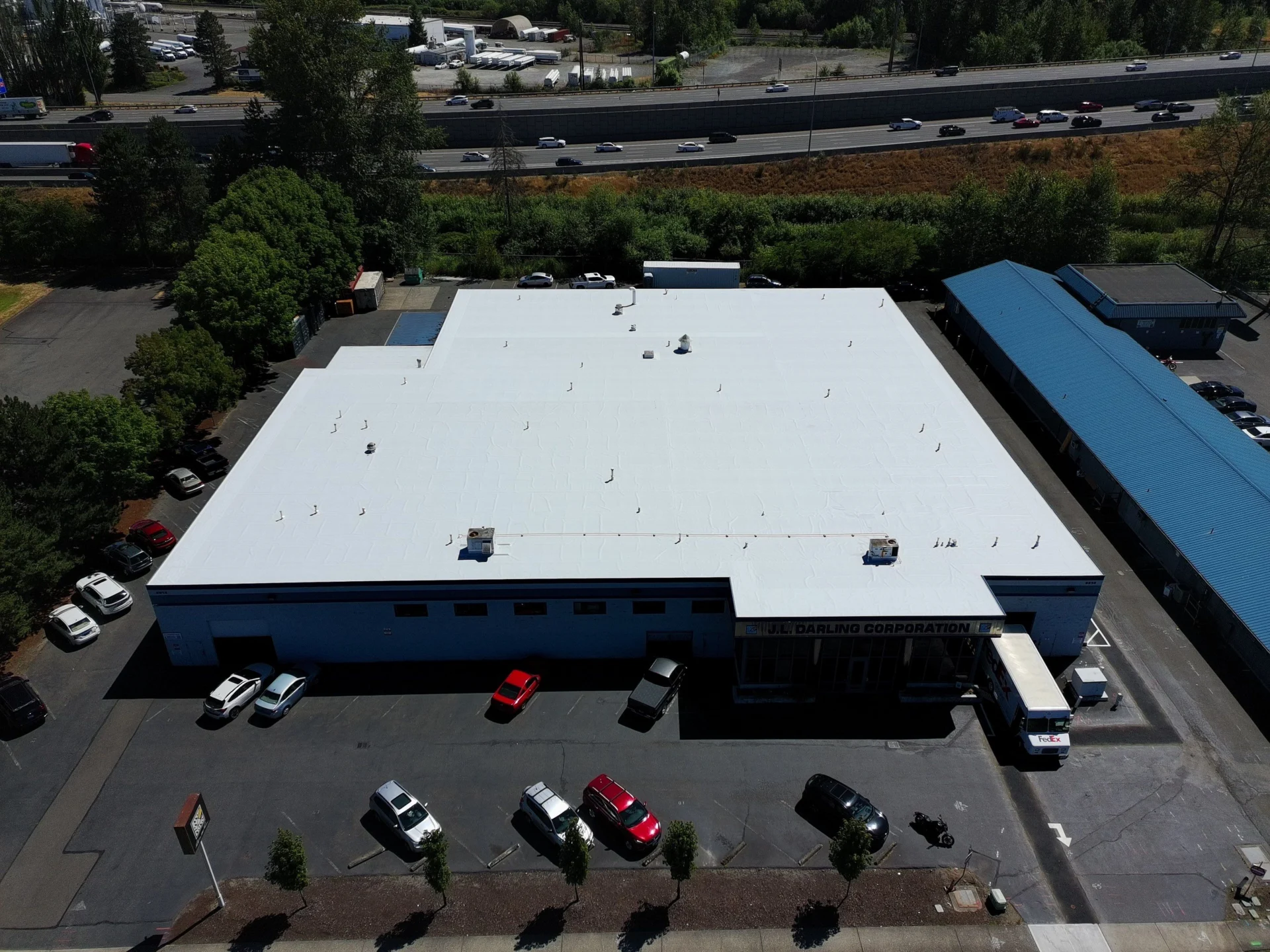
When building owners ask, “What is the best commercial roofing material?” the answer is rarely straightforward. As Rita Prokopets, Chief Operating Officer at Washington Weather Shield, explains, “One of the biggest misconceptions we see is that there’s a single ‘best’ commercial roofing system. In reality, the best roof is the one that’s engineered for your building, your climate, and your long-term goals – not simply the one with the lowest upfront cost.” The Pacific Northwest and Greater Seattle climate presents unique challenges, including persistent rainfall, ponding water, moss growth, debris accumulation, and long wet seasons. The best commercial roofing material for one building may be completely different for another depending on roof design, drainage, occupancy, maintenance goals, and budget.
Key Takeaways
- There is no single best commercial roofing material. The right system depends on your roof’s slope, drainage design, occupancy, and existing condition.
- Marine-climate performance (rain, ponding, moss, wet insulation) should drive your material shortlist before cost does.
- Building type matters: offices, industrial buildings, and multi-family properties often land on different systems for different reasons.
- Installation quality, drainage design, and flashing detail affect performance as much as the membrane itself.
- The lowest bid rarely reflects the lowest total cost once maintenance, repairs, and warranty gaps are factored in.
Table of Contents
- Commercial Roofing Material Comparison at a Glance
- What Are the Most Common Commercial Roofing Material Types?
- What Actually Determines the Best Commercial Roofing Material for a Seattle Building?
- Best Commercial Roofing Material by Building Type
- Cost Versus Value: Why the Lowest Bid Isn’t the Best Value
- How to Choose a Commercial Roofing Material With a Qualified Contractor
- FAQ
Commercial Roofing Material Comparison at a Glance
Nine systems account for nearly every commercial roof in the Greater Seattle region. Before you weigh any of them against your building, here’s how they stack up on the basics.
| Material | Typical Roof Type | Lifespan | Maintenance | Waterproofing | Best Use |
| TPO | Low-slope | 20-30 yrs | Low | Excellent | Offices, warehouses, retail |
| PVC | Low-slope | 20-30+ yrs | Low | Excellent | Restaurants, manufacturing, healthcare |
| Metal Roofing | Low- or steep-slope | 30-50+ yrs | Low | Excellent | Industrial, institutional, long-term ownership |
| Roof Coatings | Existing low-slope roofs | 10-20 yrs | Low | Good | Roof restoration projects |
| Composition Shingles | Steep-slope | 20-40 yrs | Moderate | Good | Churches, offices, HOAs, mixed-use buildings |
| Dec-Tec | Walkable surfaces | 15-20 yrs | Low | Excellent | Decks, balconies, rooftop terraces |
| Modified Bitumen | Low-slope | 15-25 yrs | Moderate | Good | Smaller commercial buildings |
| BUR | Low-slope | 20-30 yrs | Moderate | Good | Heavy-duty applications |
| EPDM | Low-slope | 20-30 yrs | Moderate | Good | Large roof areas |
Lifespan figures assume correct installation and routine maintenance. A membrane rated for 30 years can fail at year 10 if seams, flashing, or drainage were done wrong, a point we’ll come back to.
What Are the Most Common Commercial Roofing Material Types?
Several types of commercial roofing material are in common use across the Puget Sound region, from single-ply membranes to specialty deck systems. Here’s what commercial roofing material is available on the market today, and what each option actually is, before we get into which one fits your building.
TPO Roofing
TPO is the most widely installed low-slope membrane in the region. Its seams are heat-welded rather than taped, which the Insurance Institute for Business & Home Safety notes creates a bond as strong as, or stronger than, the membrane itself. TPO is also the fastest-growing single-ply membrane type nationally, according to IBHS/RICOWI research. Most TPO systems carry a polyester or fiberglass reinforcement layer for added tear resistance.
PVC Roofing
PVC shares TPO’s heat-welded seam construction but adds chemical and grease resistance TPO doesn’t offer. That makes it the go-to choice for restaurants, manufacturing plants, and other buildings where rooftop contaminants are a real concern. It typically carries a higher upfront cost than TPO, but the added resistance often pays for itself on the right building.
EPDM Roofing
EPDM is a synthetic rubber roofing membrane known for its flexibility and ease of repair, though it’s less commonly installed in the Pacific Northwest than TPO or PVC. Unlike thermoplastic membranes, EPDM seams are bonded with seam tape and adhesives rather than heat-welded.
As the roof ages, these adhesive-bonded seams can become more susceptible to separation, particularly on roofs with chronic ponding water or poor installation quality.
Modified Bitumen Roofing
Modified bitumen is an asphalt-based system reinforced with polymers for added flexibility. It’s commonly used on smaller commercial buildings and can be installed by torch-down, cold adhesive, or self-adhered methods, depending on the building and the roofing crew’s approach.
Built-Up Roofing (BUR)
BUR stacks multiple layers of asphalt and felt, usually topped with gravel or a mineral surface. That layered design gives it strong resistance to foot traffic and equipment loads, which is why it still shows up on roofs that see heavy day-to-day use.
Metal Roofing
Metal roofing spans steel, aluminum, and copper systems, and it outlasts nearly every other option on this list. It fits both low-slope and steep-slope applications, though the upfront investment runs higher than membrane systems. Its exceptional longevity, durability, and energy efficiency often make the higher initial cost a worthwhile investment over the life of the building.
Composition Shingle Roofing
Composition shingles are a steep-slope system common on churches, offices, HOA buildings, and mixed-use properties with pitched roof sections. They’re not a fit for low-slope commercial roofs, but they’re standard on the sloped portions of otherwise flat-roofed buildings.
Roof Coatings
Silicone roof coatings restore an aging but structurally sound roof rather than replacing it. When applied to the right roof, they can extend service life by years at a fraction of the cost of a full replacement. However, coatings are not a cure-all – they’re only effective when the existing roof is dry, stable, and a good candidate for restoration.
Dec-Tec Waterproof Deck Systems
Dec-Tec is a specialty walkable membrane built for decks, balconies, and rooftop gathering spaces where people, not just equipment, are on the roof regularly. It’s less common than the low-slope membranes above, but it fills a specific need on multi-family and mixed-use properties.
What Actually Determines the Best Commercial Roofing Material for a Seattle Building?
Before naming a material, work through five questions. How much rain, ponding, and moss does your roof actually see? What’s on the roof, and how often is someone walking across it? Does your building need to meet a cool-roof or energy code requirement? What’s the condition of your existing substrate? And which manufacturer systems and warranties actually cover your location?
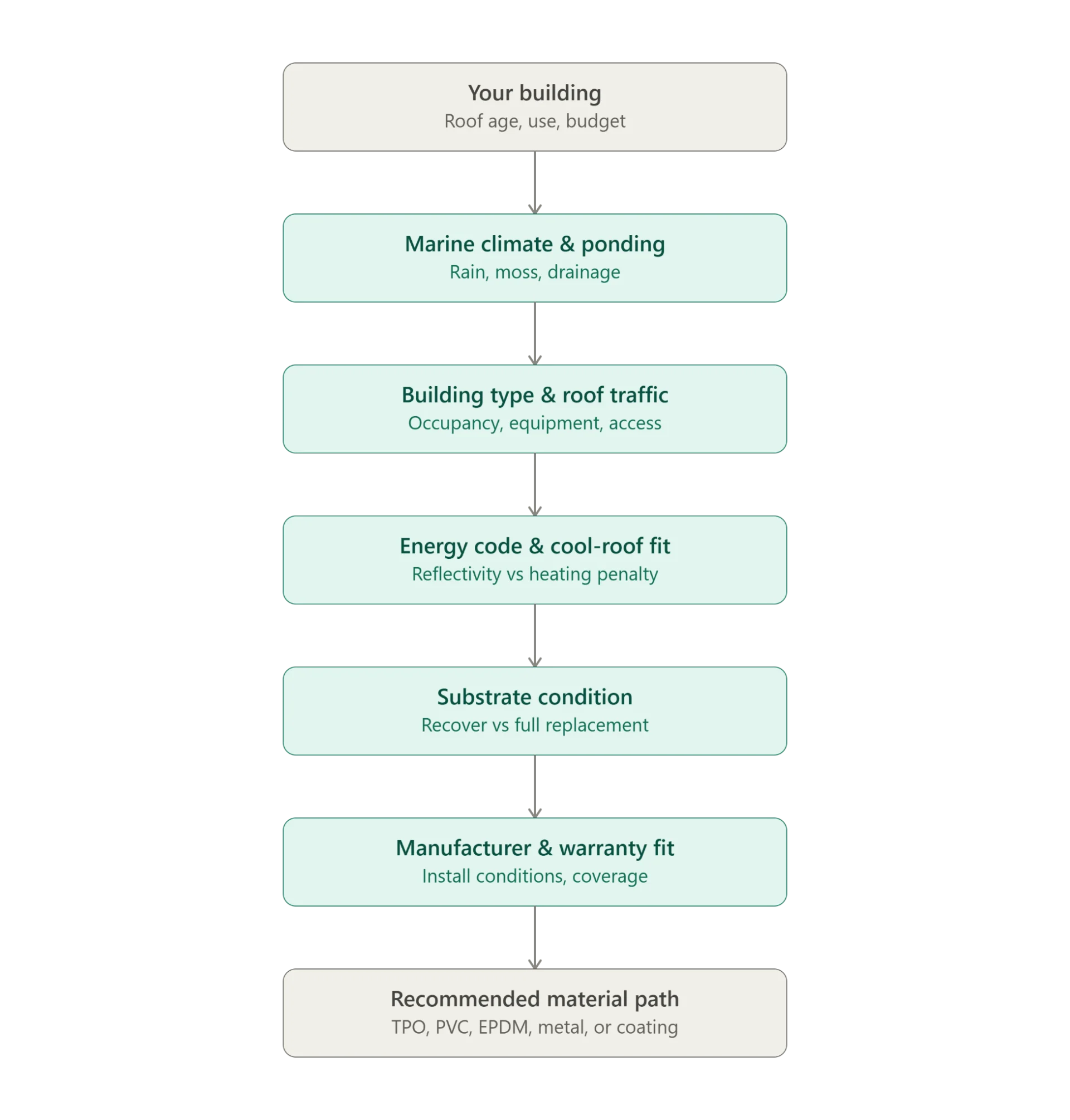
Those five factors are what determine the right system for your building.
Marine climate, rain, and ponding performance
Puget Sound’s long wet season puts every roofing system to a real test. The International Building Code requires a minimum design slope of 1/4:12 for single-ply membranes, a rule that exists precisely because ponding water is where roofs fail first.
Heat-welded systems like TPO and PVC generally handle standing water well, since the seam itself isn’t the weak point. EPDM’s taped seams are the exception worth watching. Based on WWS’s work across the nine-county service area, ponding tends to show up more often on flatter retrofit roofs than on new low-slope builds, which makes drainage design as important as the membrane choice on any recover project.
Building type, occupancy, and roof traffic
A warehouse roof with two rooftop units behaves nothing like an occupied office building with HVAC equipment, satellite dishes, and maintenance crews walking the deck every month. Traffic and equipment density change which system holds up, and how much disruption a re-roof causes tenants below. We break this down by building type in the next section.
Energy code and cool-roof requirements
Reflective membranes like white TPO can keep roof surface temperatures dramatically lower than dark alternatives. Conventional roofs can reach 150°F or more on a sunny afternoon, while a reflective roof can stay more than 50°F cooler under the same conditions, according to the U.S. Department of Energy. In non-air-conditioned buildings, the U.S. EPA found cool roofs can lower maximum indoor temperatures by 1.2 to 3.3°C (2.2 to 5.9°F).
That reflectivity comes with a Seattle-specific tradeoff. The Department of Energy notes that cool roofs can carry a winter heating penalty, since a surface that reflects more summer sun also absorbs less heat in winter. In a marine climate with a real heating season, that penalty is worth weighing against the summer cooling benefit before defaulting to the most reflective option available.
Substrate condition and recover versus full replacement
Not every roof that looks tired needs to come off. If the existing roof is still structurally sound and meets the manufacturer’s criteria for restoration, a roof coating can extend its life at a lower cost than a full tear-off. WWS has recommended exactly that on Seattle-area buildings where the existing system still had years left in it.
The reverse holds too. When the existing insulation has saturated or the deck has deteriorated, coating over the problem only delays a repair the roof already needs. The substrate’s real condition, not just its surface appearance, decides which path makes sense.
Manufacturer systems and warranty fit across the nine counties
The material on the spec sheet is only half the equation. Warranty coverage depends on installing within manufacturer conditions, and Seattle’s wet season makes that harder to guarantee than it sounds.
“Before installation begins, the roof must be clean and dry enough for the roofing system being installed, and crews often need to adjust schedules around rain events to ensure materials are applied under the manufacturer’s recommended conditions,” Prokopets says.

Working with commercial roofing material suppliers and manufacturers who stand behind their systems in this climate, brands like GAF, Versico, Duro-Last, and GE Enduris among them, matters as much across the nine-county service area as the membrane type itself.
Best Commercial Roofing Material by Building Type
While there is no single best commercial roofing material for every property, certain roofing systems tend to perform better for specific building types and operational needs.
| Building Type | Common Fit | Why |
| Office buildings | TPO | Reflectivity, low maintenance, strong waterproofing for occupied space below |
| Industrial and manufacturing | PVC | Chemical and grease resistance where rooftop contaminants are a factor |
| Warehouses | TPO or PVC | Large low-slope areas, moderate to heavy rooftop traffic |
| Healthcare facilities | TPO or PVC | Leak resistance and minimal disruption to a continuously occupied building |
| Retail properties | TPO | Cost efficiency across large, simple roof areas |
| Multi-family and mixed-use | Varies by roof section | Tenant coordination and disruption tolerance often outweigh material differences |
Many office buildings in Seattle use TPO roofing because it offers strong waterproofing performance, reflective properties, and relatively low maintenance requirements. Industrial buildings often benefit from PVC roofing due to its resistance to chemicals, grease, and rooftop contaminants that can shorten the lifespan of other roofing systems.
For occupied apartment and condominium buildings, roofing decisions often prioritize tenant coordination, long service life, and minimizing future disruptions. That means factoring in noise, odor, access to shared walkways, and how far in advance tenants need notice before crews start work, considerations that matter as much as the membrane itself on a building nobody can fully vacate during construction.
Weighing the benefits of commercial roofing material against a building’s occupancy constraints, not just its roof deck, is what actually separates a good fit from a bad one on multi-family and mixed-use properties.
While these are common recommendations, the best commercial roofing material ultimately depends on factors such as roof slope, drainage design, existing roof condition, budget, occupancy requirements, and long-term ownership goals. Two buildings of the same type may require completely different roofing solutions.
Cost Versus Value: Why the Lowest Bid Isn’t the Best Value
The lowest bid rarely tells the whole story. It can exclude insulation upgrades, flashing details, drainage improvements, or manufacturer warranty requirements that a more complete proposal includes. Two bids can look similar at a glance while covering very different scopes of work.
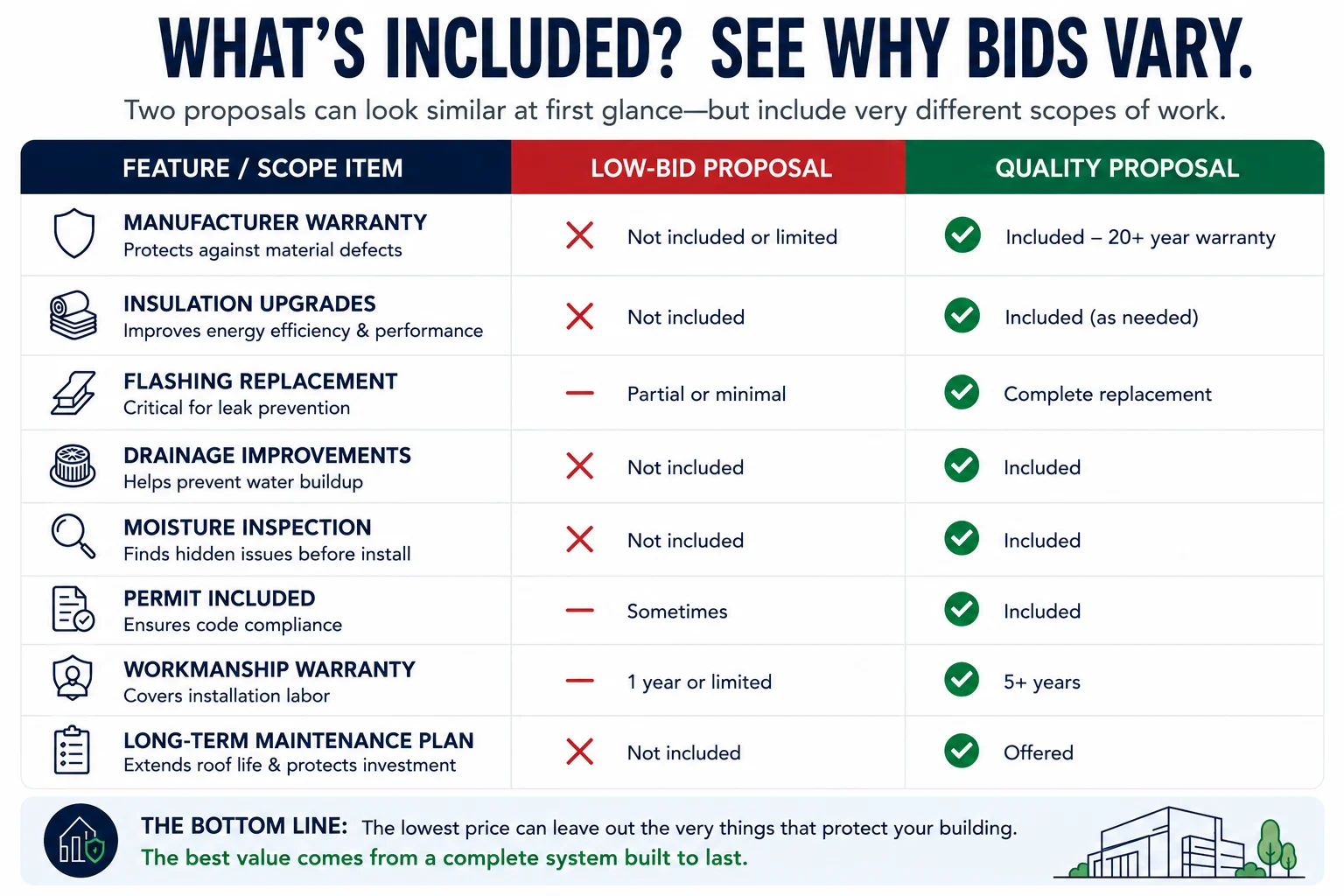
Total cost of ownership includes expected service life, maintenance needs, energy performance, and how likely the system is to need repairs down the road. A higher-quality roof that’s properly designed and installed often costs more upfront but saves money over the life of the roof by cutting repair frequency and extending replacement timing.
That math is becoming more urgent industry-wide. Insurance carriers are shortening acceptable roof ages to 15 to 20 years in many markets, according to Mordor Intelligence, which is driving a steady stream of re-roofing decisions regardless of material choice.
Design and installation quality often carry as much weight as the material itself. Inadequate slope, undersized drains, and poorly detailed flashing cause more leaks than membrane failure does. A high-quality membrane can only perform as well as the drainage, flashing, and installation details underneath it.
How to Choose a Commercial Roofing Material With a Qualified Contractor
Most commercial roof leaks don’t happen in the open field of the membrane. They happen at the details: penetrations, drains, HVAC curbs, parapet walls, skylights, and transitions between roof elevations. These are the points where movement is greatest and where a properly designed system depends on skilled installation, not just the right product on the spec sheet.
Choosing the right roofing system is just as important as choosing a qualified provider of commercial roofing services to design and install it correctly. Even the best-rated membrane fails early if the crew welding its seams or flashing its penetrations cuts corners.
“Rather than asking, ‘What’s the best roofing material?’ we encourage property owners to ask, ‘What’s the best roofing solution for my building?'” Prokopets says. “That reframing, from material to solution, is the single most useful lens for narrowing your options.”
FAQs
What is the best commercial roofing material?
There isn’t one material that fits every building. TPO and PVC tend to perform well on most Seattle low-slope commercial roofs thanks to heat-welded seams and strong ponding resistance, but the right choice depends on your building’s slope, occupancy, existing condition, and budget.
What is the best roofing for commercial buildings?
For low-slope commercial roofs, which cover most offices, warehouses, and retail buildings, single-ply membranes like TPO and PVC are the most common fit. Steep-slope sections on the same property often use metal or composition roofing instead.
Which is better: TPO, PVC, or EPDM?
For most commercial buildings in Western Washington, we typically recommend TPO or PVC over EPDM. Both membranes use heat-welded seams that provide superior protection against water intrusion and are better suited to the region’s frequent rainfall and ponding conditions. EPDM has a proven track record but relies on adhesive-bonded seams that require more ongoing attention as the roof ages. The right choice ultimately depends on the building’s design, budget, and performance goals.
Is there any roofing product that lasts 80 years?
No commercial roofing material on the market today carries a realistic 80-year service life. Premium metal roofing systems can reach 50 years or more with proper installation and maintenance, which is close to the upper end of what’s realistically achievable.
What are the top 5 roofing materials?
TPO, PVC, metal roofing, EPDM, and modified bitumen account for the large majority of commercial roofs in the Puget Sound region. Built-up roofing, coatings, composition shingles, and specialty systems like Dec-Tec fill in the remaining applications.
Choosing the Right Material for Your Building
What is the best commercial roofing material for your building comes down to how it performs against your roof’s slope, drainage, occupancy, and existing condition, not which system has the most name recognition. Get a site-specific assessment before committing to a material, and weigh the contractor’s installation quality as heavily as the product itself.
Schedule a roof assessment with Washington Weather Shield to get a written scope for your building before you commit to a material.
References
- U.S. Department of Energy. (n.d.). Cool Roofs. Energy Saver. https://www.energy.gov/energysaver/cool-roofs
- U.S. Environmental Protection Agency. (n.d.). Using Cool Roofs to Reduce Heat Islands. https://www.epa.gov/heatislands/using-cool-roofs-reduce-heat-islands
- Insurance Institute for Business & Home Safety. (n.d.). RICOWI Roof Guide: Single-Ply Membrane. https://ibhs.org/guidance/ricowi-roof-guide-single-ply-membrane/
- Mordor Intelligence. (2025). United States Roofing Market. https://www.mordorintelligence.com/industry-reports/united-states-roofing-market