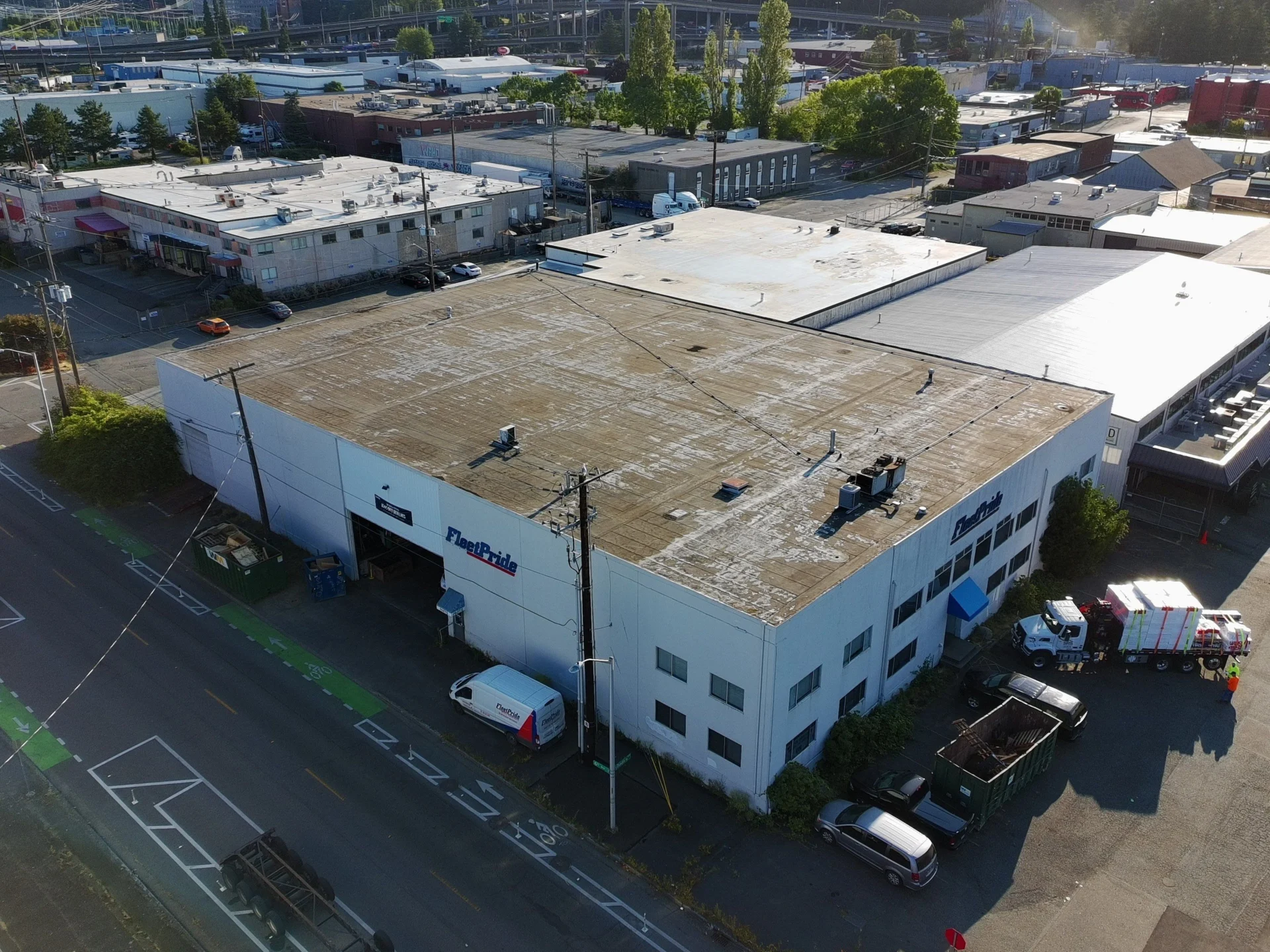
Most leak calls start the same way. A tenant reports a ceiling stain, someone blames last week’s windstorm, and the roof gets a patch. But on low-slope commercial buildings across the Greater Seattle area, the weather that reveals a leak is not always what caused the underlying damage. A storm may expose a seam, flashing detail, or penetration that had already been deteriorating over time.
That distinction matters because it changes what happens next. It can affect what should be documented, whether the damage may be related to a recent weather event, and whether a localized repair makes sense or a larger roofing issue needs to be addressed.
Key Takeaways
- Most commercial leak calls trace back to an aging system, not a single weather event.
- The earliest signs of roof damage sit at seams, flashings, penetrations, and sealants, long before anything shows inside.
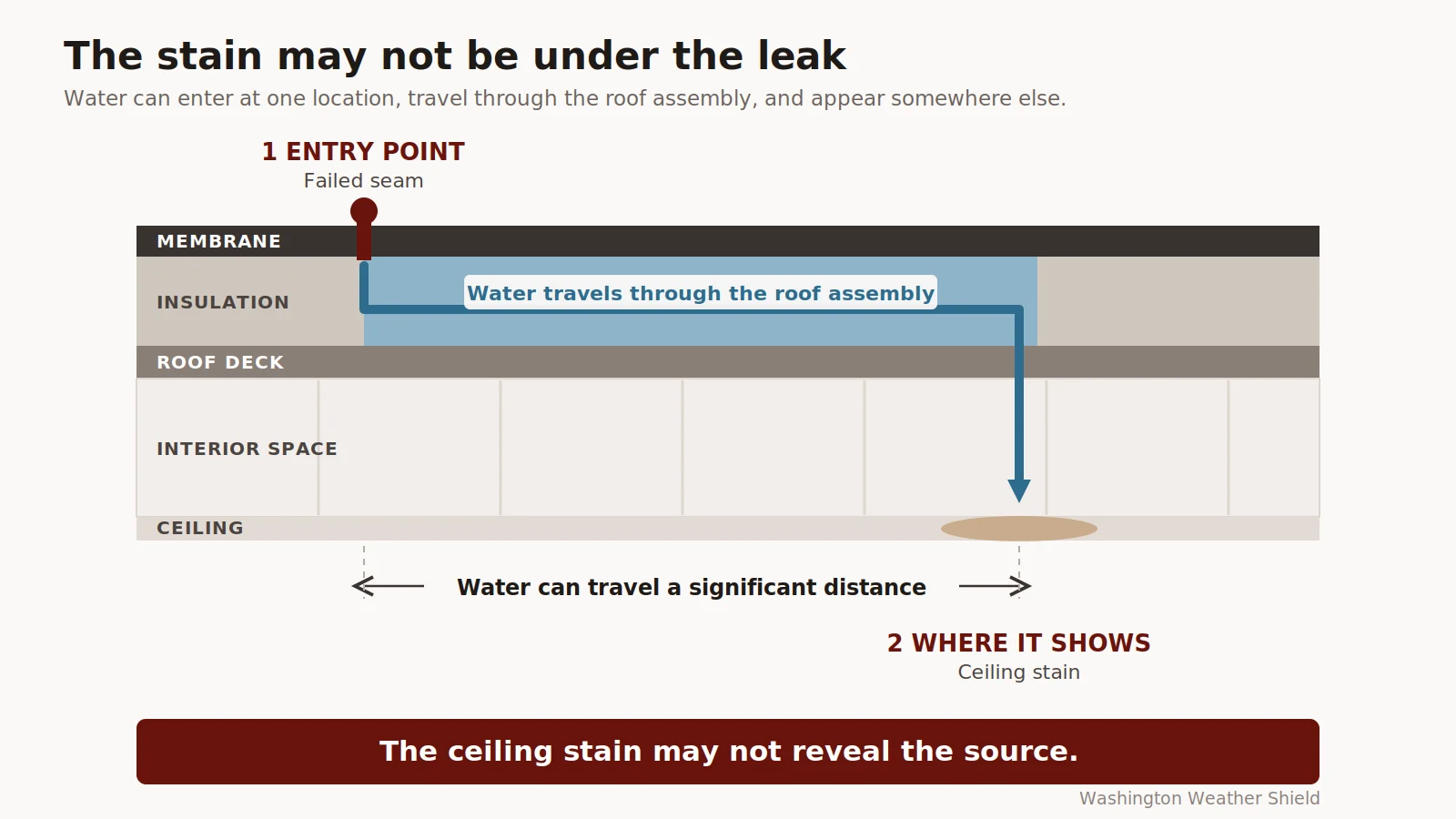
- Water travels along decking before it drops, so a ceiling stain rarely marks the entry point.
- Recent storm damage and long-term deterioration can present differently. Documenting the condition of the roof can be especially important when an insurance claim may be involved.
- Localized repair stops making sense once the same area has failed repeatedly, or once the rest of the roof matches its condition.
- Buildings that cannot tolerate a leak need a shorter inspection cycle, not a different repair method.
Why commercial roof damage rarely announces itself
The Insurance Institute for Business and Home Safety, in its Commercial Roofs: Best Practices guide, describes the roof as a commercial building’s “first line of defense” against wind, rain, hail, ice, and snow. IBHS also identifies the roof as one of the most vulnerable parts of a building.
Both can be true at once. A commercial roof can withstand years of exposure while deterioration gradually develops at seams, flashings, penetrations, drainage areas, and other vulnerable details.
When our crews respond to leak calls, we frequently find that the problem did not begin with the most recent storm. On older roofing systems, including aging torch-down roofs, we may find cracking and deterioration along with failing seams, flashings, penetrations, or sealants that have created a path for water intrusion.
Storms tend to get blamed because storms are memorable. The seam that gradually deteriorated over years is not.
“Our clients sometimes assume roof damage will be obvious. On low-slope roofs, small cracks, failing seams, deteriorated flashing, or trapped moisture can cause significant problems long before there are visible signs inside the building.”
- Ivan Prokopets, Owner & CEO, Washington Weather Shield
That gap between when deterioration begins and when someone notices it is what makes commercial roof damage difficult to manage. By the time a tenant reports a ceiling stain, water may have already traveled through portions of the roof assembly or affected insulation and other materials beneath the membrane.
The signs a low-slope roof gives you first
Interior signs a tenant reports before you see anything
Ceiling stains, water rings, bubbling paint, sagging ceiling tiles, musty odors, and unusual humidity are often the first signs tenants notice.
But the visible stain rarely marks the actual entry point. Water can travel along decking and framing before it drops into the space below, which is why tracing the leak from the roof matters.
IBHS commercial roof guidance recommends checking the roof deck and framing from below for:
- moisture or deterioration
- rotting or rusting
- excessive deflection
- signs of stress below areas prone to ponding
If structural movement or deterioration is found, a licensed structural engineer may need to evaluate it further.
What shows up on the roof surface
Some of the most common signs of roof damage are visible on the roof itself:
- open or separated seams
- punctures, tears, and blisters
- cracked or deteriorated sealant
- loose or displaced edge metal
- surface cracking or soft areas
- standing water that remains after rain
- moss, leaves, or debris blocking drains and scuppers
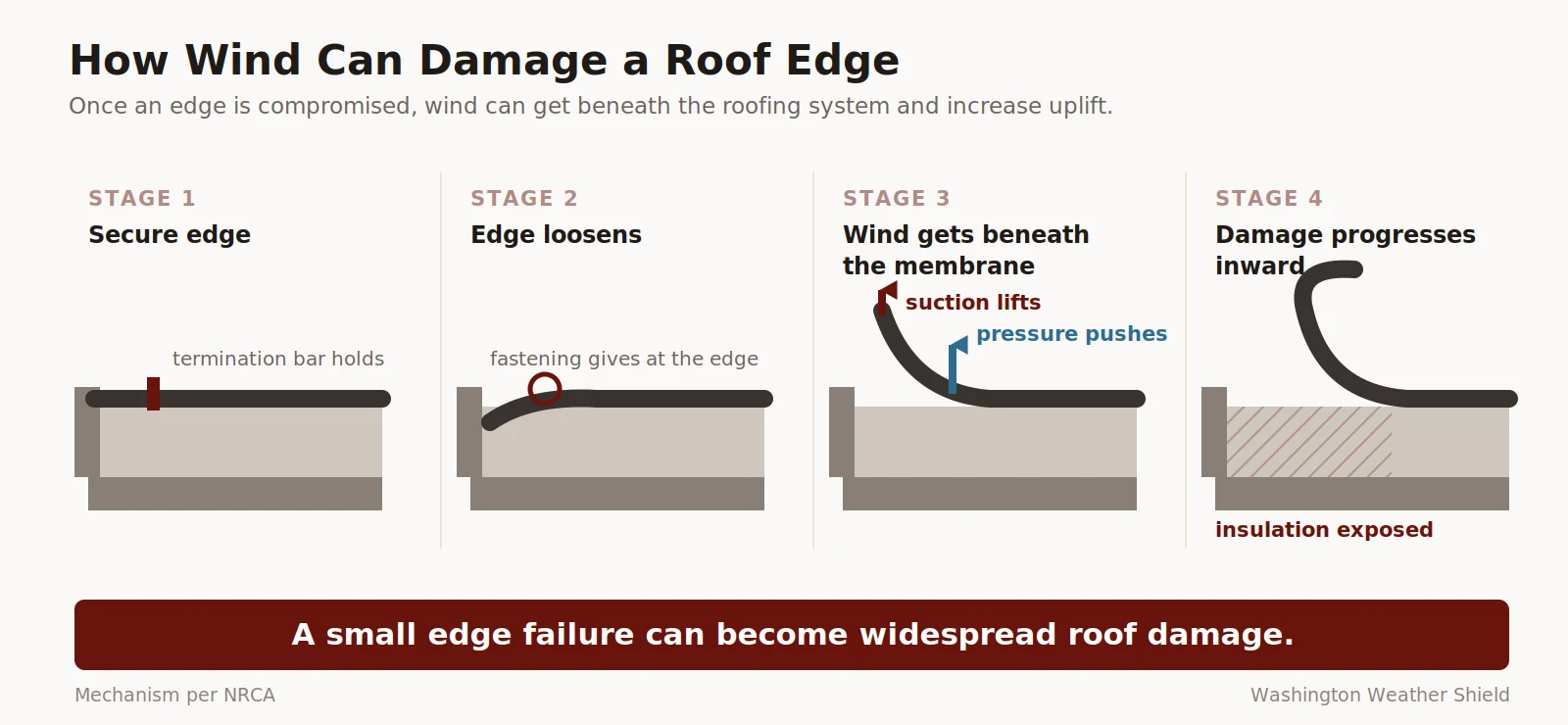
Roof edges deserve extra attention because they are particularly vulnerable to wind damage. Loose flashing, coping, or other perimeter details can create an opening for wind to get beneath the roofing system and begin lifting or separating materials.
IBHS recommends reinforced perimeter details on single-ply roofing systems to improve wind resistance. When these components are loose, damaged, or inadequately secured, the roof becomes more vulnerable during high-wind events.
Finding moisture you cannot see
Saturated insulation can turn a relatively contained roof problem into a much larger one. Once moisture gets beneath the membrane, it can reduce the insulation’s performance and increase the amount of material that may need to be removed and replaced during repairs.
The Whole Building Design Guide from the National Institute of Building Sciences lists five established methods for testing horizontal membrane integrity:
- spray testing
- flood testing
- capacitance testing
- nuclear metering
- infrared thermal imaging.
Two newer electrical methods sit alongside them, low-voltage conductance testing and high-voltage spark testing. Named standards include ASTM C1153 for locating wet insulation with infrared, ASTM D5957 for flood testing, and ASTM D7877 for electronic leak detection.
Infrared carries a limit worth knowing before you order a scan. WBDG notes that an infrared scan outlines areas of wet insulation that could come from condensation or from problems other than a membrane breach. Scans usually run at dusk or in the early evening, and the result tells you where to open the roof, not why the water got there.
What does roof damage look like on TPO, EPDM, PVC, and metal?
| System | What the damage looks like | Where it usually starts |
| TPO and PVC | Seam separation, punctures, surface crazing, blisters, shrinkage at terminations | Seams, penetrations, equipment curbs |
| EPDM | Blisters and bubbles, shrinkage pulling at laps, punctures, deteriorated flashing | Seams, flashing terminations, corners |
| Modified bitumen | Surface cracking, granule loss, open laps, blisters, failing sealant | Laps, base flashings, low spots |
| Built-up roofing | Alligatoring, surfacing loss, ridging, open felts | Flashings, drainage low points |
| Metal | Fastener backout, corrosion, panel movement, sealant failure at joints | Transitions, penetrations, panel ends |
| Any system | Soft or spongy areas underfoot, standing water, deteriorated sealant | Drainage low points, penetrations |
Metal is the system most often assessed with the wrong checklist, because its failures are mechanical rather than membrane-related. Fasteners back out, panels move with thermal cycling, sealant gives up at transitions, and corrosion starts where two metals meet. None of that looks like a puncture, and none of it appears on a single-ply inspection form.
What damages commercial roofs the most in the Greater Seattle Area
Roof wind damage starts at the edges
The National Roofing Contractors Association describes the mechanism plainly: most wind damage begins at the edges of roof systems. Once material loosens, suction lifts it while pressure pushes against it, exposing the underside and giving the wind more to grab. NRCA calls the result a peeling effect.
NRCA makes a second point that lands directly in your insurance file. The damage starts small and grows through repeated wind cycles, usually over time. A roof section that let go in a 50 mph gust had often been losing that edge for years.
Sustained rain, ponding, and blocked drains
Our storm profile is duration rather than intensity. Roofs here stay wet for months at a stretch, so drainage carries load continuously instead of in short peaks.
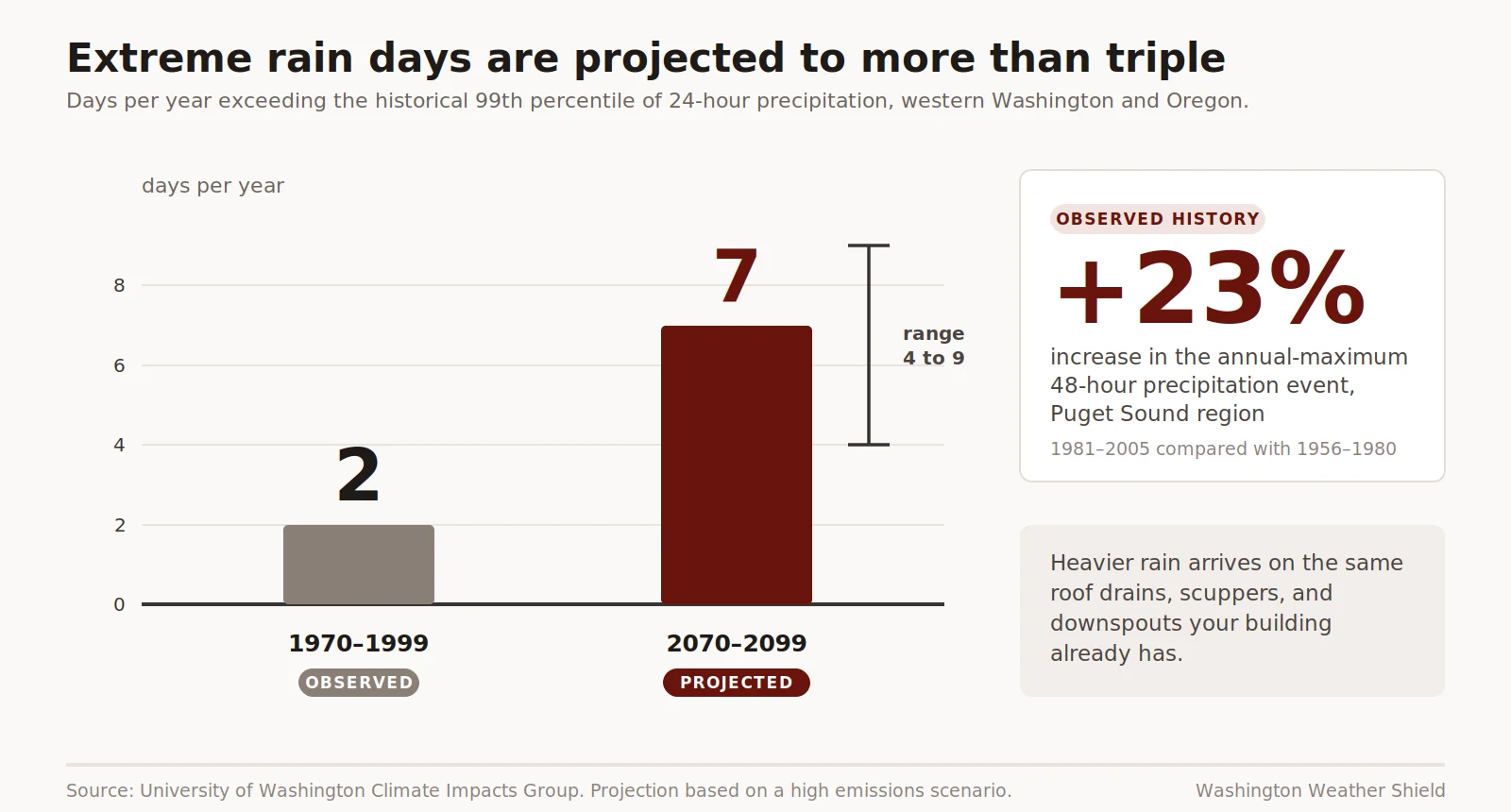
That load is growing. Two figures from the University of Washington Climate Impacts Group:
- A 23% increase in the annual-maximum 48-hour precipitation event for the Puget Sound region, comparing 1981 through 2005 against 1956 through 1980. Observed history, not a projection.
- From about 2 extreme rain days a year to about 7. Days exceeding the historical 99th percentile of 24-hour precipitation, comparing 1970 through 1999 against a projection for 2070 through 2099 in western Washington and Oregon under a high emissions scenario.
Rain alone is often not the problem. Blocked drainage can turn routine rainfall into standing water that puts additional stress on an already vulnerable roof. Three things clog a low-slope roof here:
- Leaves and needles from tree cover on or around the site, heaviest in the fall.
- Windblown debris after a storm. NRCA advises that a post-wind inspection account for what blew onto the roof, not only whether attachments held.
- Moss, which on a commercial flat roofing system holds water against the surface and migrates into the drains.
On one project in Snohomish surrounded by heavy tree cover, leaves and debris clogged the roof drains repeatedly and left water standing across the field. Over time, this led to decay and water intrusion, turning something routine roof cleaning would have prevented into a much larger repair.
Roof damage from hail: what actually happens here
National roofing articles lead with hail. In the Puget Sound region that emphasis is misplaced, and the Climate Impacts Group explains why. “Thunderstorms are rare here because of cold ocean temperatures and warm upper air”.
Roof hail damage still deserves recognition when it occurs. On a membrane, it appears as dents, bruising, and small punctures, often clustered and difficult to see from any distance. On metal, it shows as dents across panels and flashing, plus damage to rooftop equipment. IBHS recommends hail guards for condenser fins, air intakes, and fans, which is where hail does its most expensive work.
What we see far more often is roof damage from hail invoked to explain a decade of deterioration. A hail damage roof inspection should confirm an impact pattern, not assume one.
Rooftop equipment and foot traffic
Many national roofing articles give significant attention to hail damage. In the Puget Sound region, however, hail is generally a less prominent roofing concern than persistent moisture, wind, and long-term weather exposure. The University of Washington’s Climate Impacts Group notes that thunderstorms are relatively rare in the region, in part because of the influence of cool ocean temperatures and atmospheric conditions.
Hail damage still deserves attention when it occurs. On membrane roofing systems, impacts may leave dents, bruising, or punctures that can be difficult to identify from a distance. On metal roofs, hail can dent panels, flashing, and rooftop equipment. IBHS also recommends protecting vulnerable rooftop equipment, including condenser fins, air intakes, and fans, from hail impact.
The important distinction is whether the observed damage is consistent with a recent hail event or with longer-term roof deterioration. A hail damage roof inspection should document the location and pattern of suspected impacts while also evaluating the overall age and condition of the roofing system. Hail should not automatically be assumed to be the cause simply because damage is present.
Telling new roof storm damage from years of wear
When storm damage may be involved, one of the most important questions is whether the condition is new or the result of long-term deterioration. It is also one of the hardest questions to answer when there is no documented history of the roof’s condition before the storm.
| Recent storm damage | Long-term deterioration |
| Newly lifted or displaced membrane | Cracking and worn surfaces |
| Loose or displaced metal | Degraded sealant |
| Punctures and impact marks | Corrosion |
| Damage concentrated where the event struck | Evidence of previous leaks and repairs |
“Fresh storm damage typically has clear signs like newly lifted or displaced membrane, loose metal, punctures, or impact damage. Long-term deterioration usually shows aging patterns such as cracking, worn surfaces, degraded sealant, corrosion, or evidence of previous leaks and repairs.”
- Ivan Prokopets, Owner & CEO, Washington Weather Shield
NRCA’s account of wind mechanics supports the same reading from the opposite direction. If damage grows through repeated cycles over time, a storm can expose a failure it did not cause. Roof damage from storm events and roof damage revealed by a storm are two different claims, and documentation is what separates them.
What to do in the first 48 hours after a storm
Sequence matters, and safety comes before evidence, so tenants should not go up on the roof right after severe weather.
- Check the interior first. Walk top-floor spaces, collect tenant reports, and note the time each one came in.
- Contain active leaks. Protect equipment, inventory, and records below before anything else.
- Walk the perimeter at ground level. Look for displaced metal, debris, blocked downspouts, and water visible from below.
- Document while conditions are fresh. Photograph inside and outside the same day, with every date recorded.
- Schedule a storm damage roof inspection. A qualified commercial contractor assesses the roof surface and, where needed, the deck and framing from below.
One rule from NRCA is worth passing to anyone who reaches the roof before your contractor does. Do not puncture blisters, and do not spread coating or mastic before the damage has been assessed. Doing so covers up the evidence a roofing contractor needs to diagnose the problem. Cover openings temporarily with tarps instead, and keep receipts for any temporary repair.
How to document roof damage for contractors, adjusters, and warranty files
“Usually, it’s missing clear photos of the actual damage and enough context to show where it is located on the roof. We also often see missing documentation of the roof’s overall condition, which can help distinguish storm-related damage from normal wear and deterioration.”
- Ivan Prokopets, Owner & CEO, Washington Weather Shield
Good documentation answers three questions: what the damage is, where it sits on the roof, and what the roof looked like before. Most files answer only the first.
What to capture:
- Date-stamped photographs of each damaged area, plus wider shots that place it on the roof
- A roof plan or sketch with affected areas marked and numbered
- Interior leak locations mapped against their roof-side positions
- The date and time of the weather event, with the tenant reports that followed
- Maintenance and repair history for the same areas
- Overall roof condition, including the areas that are sound
- A severity note and a repair recommendation for each item
Weather evidence is easier to get than most teams realize. The National Weather Service Seattle office publishes a daily climate report showing observed versus normal precipitation, including water-year-to-date totals. Pulling the official record for a specific date ties damage to a documented event, which is what an adjuster asks for. NRCA also notes that reinspections, where the adjuster and the roofing contractor review the damage together, are common.
When damage may support an insurance claim
Insurers separate sudden events from gradual wear, and that line runs through every commercial roof claim. Newly lifted or displaced material, impact marks, and leaks that began after a documented weather event sit on one side. Progressive cracking, corrosion, degraded sealant, and areas already repaired several times sit on the other.
Deferred maintenance is where claims tend to fail. A roof with no inspection history and no condition record gives an adjuster nothing to compare against. Damage that genuinely came from a storm then gets read as wear.
Before filing a claim, gather clear documentation of the damage, the weather event, and the roof’s maintenance history. A written contractor report can help show whether the roof damage is consistent with a sudden event or long-term wear.
Coverage ultimately depends on your policy, so confirm claim-specific questions with your carrier or broker.
Repair, restoration, or replacement: where the line falls
A localized repair is the right answer more often than people expect. Isolated punctures, a failed penetration seal, or a section of open seam on an otherwise sound roof are all repairs. Treating them as anything more wastes budget.
“When the same area has been repaired multiple times and continues to leak, or when the rest of the roof shows the same level of deterioration as the problem area. At that point, localized repairs are usually just a temporary fix.”
- Ivan Prokopets, Owner & CEO, Washington Weather Shield
That gives you two conditions to test against, and either one on its own moves the decision toward replacement. Restoration through a coating system sits between repair and replacement, and it works when the substrate is sound and the insulation below is dry. It does not work as a cover for saturated insulation. Cost drivers across all three paths include system type, roof size and access, tear-off versus recover, decking condition, insulation and code upgrades, and warranty tier.
A simple severity scale keeps these calls consistent across a portfolio:
- Urgent. Active leak over occupied space, equipment, or inventory. Structural deflection or a large open breach. Response measured in days.
- Priority. Open seams, failed flashing, standing water, or punctures with no interior symptom yet. Repair scheduled this season.
- Monitor. Surface wear, minor sealant deterioration, isolated debris. Recorded, photographed, and re-checked at the next inspection.
How building use changes the threshold
Tolerance for a leak, not roof condition alone, sets the response. A hospital, a school, or a warehouse with inventory stacked below carries far lower risk tolerance than a single-tenant office with a flexible schedule. For those buildings we recommend more proactive inspections and preventative maintenance, and we put urgent needs there at the front of the queue to protect operations, equipment, and inventory.
The consequences are specific rather than abstract, and saturated ceiling tile falling into occupied space is only the first one. Water on a floor becomes a slip hazard in an area with no ground-fault protection. Inventory, production equipment, and paper records rarely survive once wet, and the downtime usually costs more than the roof work.
FAQs
What is roof damage on a commercial building?
Commercial roof damage includes conditions that compromise the roofing system or increase the risk of water intrusion. Common examples include punctures, separated seams, damaged flashing, deteriorated sealant, corrosion, membrane deterioration, and moisture within the roof assembly.
On low-slope roofs, problems frequently develop around seams, penetrations, flashings, drainage areas, and other roof details. Some damage can exist well before there are visible signs inside the building.
What is the most common roof damage?
In our experience across the Greater Seattle area, many of the problems we find are related to aging roofing systems and deterioration that develops over time. Seams, flashings, penetrations, and sealants are common problem areas, while older torch-down systems may also develop cracking and surface deterioration.
Weather can cause new damage, but it can also expose weaknesses that were already developing. A roof inspection can help distinguish between the two.
How do I know if my roof has storm damage?
After a significant weather event, look for changes such as lifted or displaced membrane, loose or missing metal, punctures, damaged flashing, or other conditions that were not previously present.
Previous inspection reports and dated photographs can be especially valuable because they provide a record of the roof’s condition before the event. If an insurance claim may be necessary, document the conditions you find before repairs are made whenever it is safe and practical to do so.
What does hail damage look like on a roof?
Hail damage can look different depending on the roofing system. On membrane roofs, impacts may leave dents, bruising, punctures, or other surface damage. On metal roofs, hail may leave dents in panels, flashing, or rooftop equipment.
Not every mark on a roof is evidence of hail damage. Age, foot traffic, previous repairs, dropped tools, and other conditions can create damage that looks similar, which is why the overall pattern and condition of the roof should be evaluated.
What size hail will damage a roof?
There is no single hail size that will damage every commercial roof. The outcome depends on several factors, including hailstone size and density, wind speed, impact angle, roofing material, roof temperature, and the age and condition of the system.
Instead of relying on hail size alone, a roof inspection should look for physical evidence consistent with impact damage and consider whether hail was reported in the area during the suspected event.
How much hail damage does it take to replace a roof?
There is no universal number of hail impacts that automatically requires a commercial roof replacement. The appropriate response depends on the extent and severity of the damage, the roofing system, whether the membrane or underlying materials have been compromised, and the overall condition of the existing roof.
Localized damage on an otherwise serviceable roof may be repairable. More widespread damage, particularly on an aging roof or where moisture has entered the roof assembly, may justify considering a larger repair or replacement. If an insurance claim is involved, coverage and the appropriate scope will ultimately depend on the policy, documented damage, and carrier evaluation.
What to do about roof damage on your building
If you have discovered roof damage or are unsure whether a recent weather event affected your building, the first step is understanding what actually happened.
Washington Weather Shield can inspect the roof, photograph and document our findings, identify areas that need attention, and provide a written scope for recommended repairs. If an insurance claim is involved, that documentation can also provide useful information about the observed condition of the roof.
Call Washington Weather Shield at 206-504-1500 or email info@waweathershield.com to schedule a commercial roof inspection in the Greater Seattle area.
References
- Insurance Institute for Business & Home Safety. Commercial Roofs: Best Practices. https://ibhs.org/wp-content/uploads/Commercial-Roofs-Best-Practices.pdf
- National Roofing Contractors Association. Roof Repair After Strong Winds. https://nrcawebstorage.blob.core.windows.net/files/nrca_website/documents/technical/Roof-Repair-After-Strong-Winds.pdf
- National Roofing Contractors Association. Consumer Advisory Bulletin, Issue 4: Maintenance. https://nrcawebstorage.blob.core.windows.net/files/nrca_website/documents/technical/Consumer-Advisory-Bulletin-Issue-4-Maintenance.pdf
- University of Washington Climate Impacts Group, 2015. State of Knowledge: Climate Change in Puget Sound, Section 2: Climate. https://cig.uw.edu/wp-content/uploads/sites/2/2014/11/ps-sok_sec02_climate_2015.pdf
- National Institute of Building Sciences, Whole Building Design Guide. Integrity Testing of Roofing and Waterproofing Membranes. https://www.wbdg.org/resources/integrity-testing-roofing-and-waterproofing-membranes
- NOAA National Centers for Environmental Information. U.S. Climate Normals, 1991-2020. https://www.ncei.noaa.gov/products/land-based-station/us-climate-normals
- National Weather Service Seattle. Daily Climate Report. https://forecast.weather.gov/product.php?site=NWS&product=CLI&issuedby=SEA