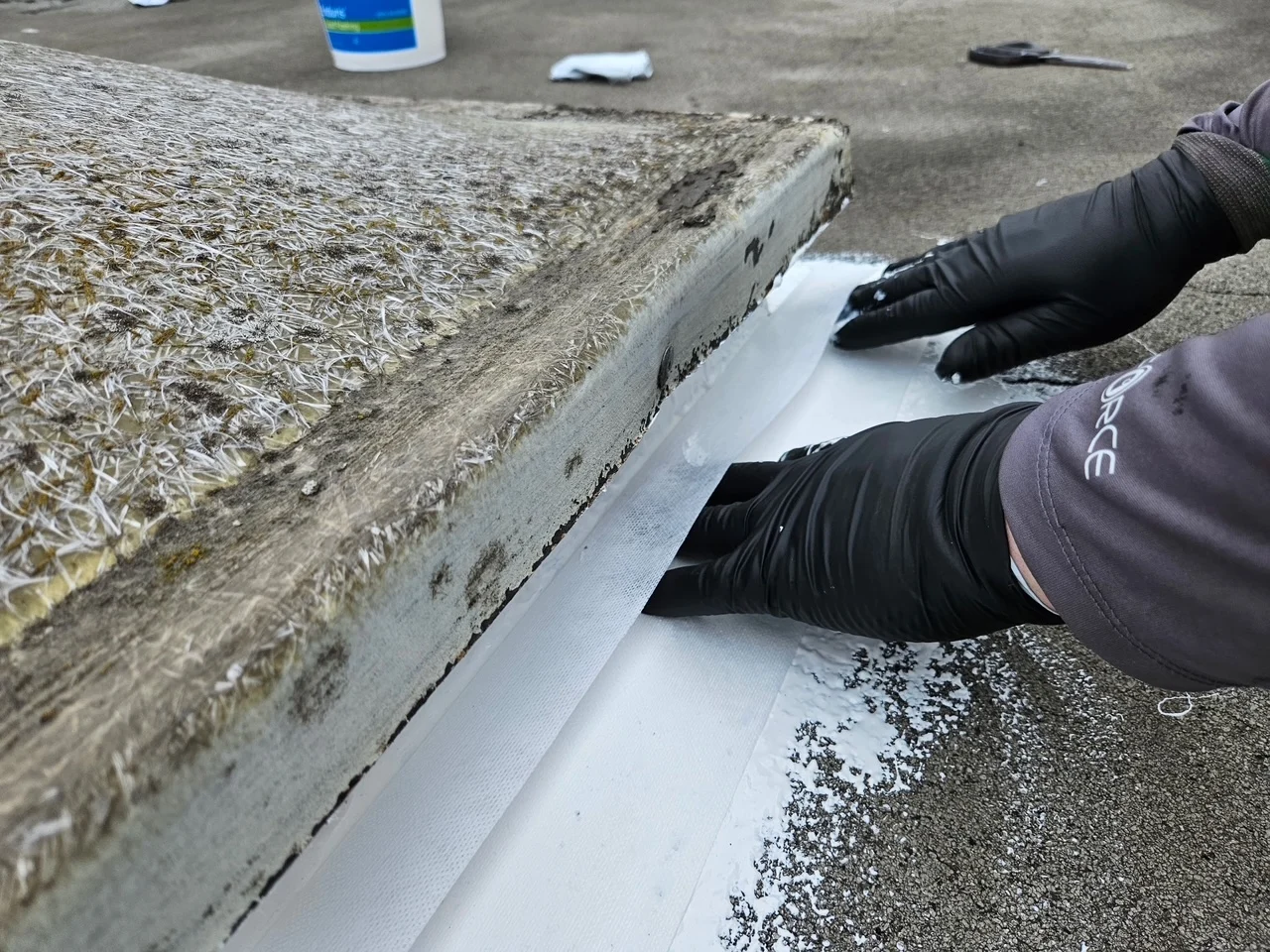
A sealant bead cracks at an HVAC curb sometime in August. Nobody sees it. Leaves fill the low corner beside a drain through October, and the first sustained November rain finds both problems at once. By January, there is a stain spreading across a tenant’s ceiling tile.
That sequence is how most commercial roofs fail in this region, and no single storm caused any of it. A long wet season worked steadily on two small problems that nobody had looked at since summer.
This commercial roof maintenance checklist covers what to inspect and why each item matters on a building in the Greater Seattle area.
Key takeaways
- Two professional visits a year is the working baseline for most commercial buildings here, timed to late fall and late winter.
- Drainage is the highest-value item on any roof maintenance checklist in this climate, because blocked drains turn rainfall into standing water and structural load.
- Flashing, coping, and penetrations produce more leaks than open field membrane, and several early warning signs are visible without specialized equipment.
- Clearing debris is housekeeping, while a program adds inspection, correction, and a documented record.
- That record does double duty, satisfying manufacturer inspection requirements and separating storm damage from pre-existing conditions during a claim.
Table of contents
- Routine maintenance, preventive programs, and reactive repairs
- The checklist, zone by zone
- Flat and metal roofs need different attention
- How often should a commercial roof be inspected?
- What documentation actually protects you
- What changes by building type
- What you can check safely
- Frequently asked questions
Routine maintenance, preventive programs, and reactive repairs
Property managers often hear these terms used interchangeably, but they describe three very different approaches. Confusing them can become expensive.
Routine maintenance
Routine commercial roofing maintenance is basic housekeeping: clearing debris, opening drains, and sweeping the surface. It keeps water moving, but it primarily addresses conditions visible at the roof surface.
Preventative roof maintenance
Preventative roof maintenance goes further. It follows a schedule to inspect flashings, sealants, seams, penetrations, drains, and scuppers. Small issues are corrected during each visit, and every condition is documented.
A commercial roof maintenance plan turns that work into a repeatable process, with scheduled visits and a clear maintenance record.
Reactive repair
Reactive repair starts after a leak appears. By then, you may already be in the middle of the wet season, with a tenant waiting and a schedule you did not choose.
The National Roofing Contractors Association frames maintenance as “proactive rather than reactive work,” identifying problems while they can still be corrected. That distinction is the core value of professional roof maintenance.
At Washington Weather Shield, we see the cost of this confusion across commercial buildings throughout the Greater Seattle area.
“We’ve seen property owners skip these inspections because the roof ‘looked fine,’ only to discover that a minor sealant failure or clogged drainage system had led to interior water damage.” – Rita Prokopets, COO, Washington Weather Shield
What each approach actually covers
| Routine maintenance | Preventive program | Reactive repair | |
|---|---|---|---|
| What happens | Debris and drain clearing | Scheduled inspection, correction, documentation | Repair after a leak appears |
| What it catches | Blocked drainage, surface debris | Sealant, flashing, seam, and penetration failures before water enters | The failure, after interior damage |
| Timing | As needed | Scheduled, typically twice annually | Unscheduled, usually mid-storm |
| Documentation | Rarely | Photo log, condition report, warranty file | Incident record only |
| Tenant impact | None | Planned and low | Disruption has already happened |
| Typical cost | Lowest upfront cost: $500–$1,500 per visit | Predictable, planned annual expense: $500–$1,500 per visit | Highest and least predictable: $2,000–$10,000+ depending on the failure; significantly more if water has damaged insulation, decking, or interiors |
The checklist, zone by zone
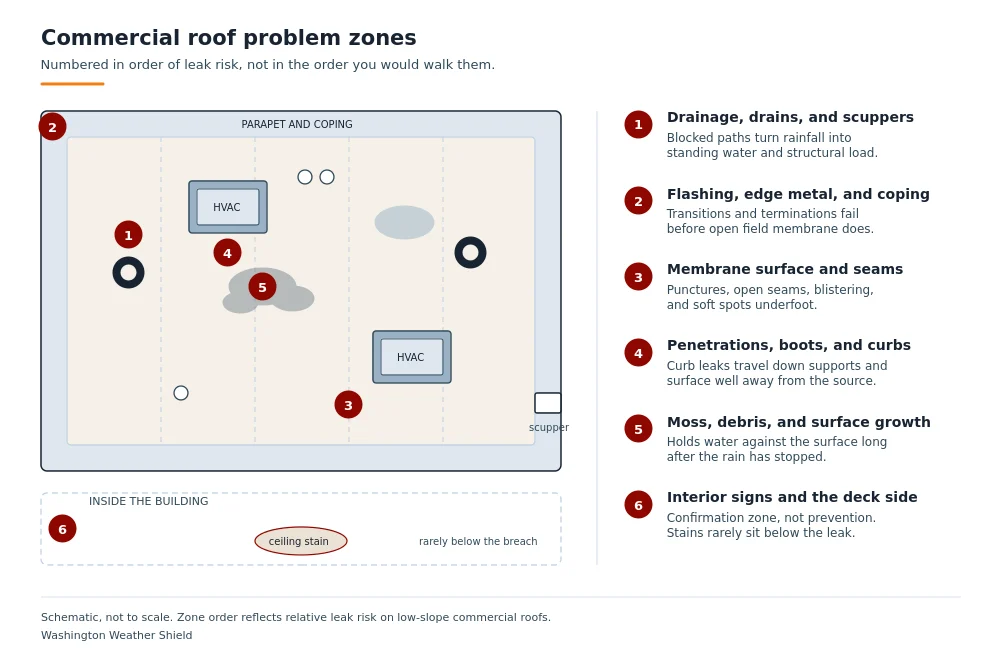
A roofing maintenance checklist is most useful when you understand why each item matters. The six zones below run in order of leak risk rather than in the order you would walk them. Each item pairs the check itself with the failure that follows when nobody performs it.
Drainage, drains, and scuppers
Drainage belongs near the top of any roofing maintenance checklist, especially for flat roof maintenance. Water has to leave the roof, and when it cannot, every other weakness gets worse.
What to check:
- Primary drains: Remove debris, leaf buildup, and biological growth around the strainers.
- Overflow drains and scuppers: Confirm they are clear, since they provide the code-required secondary drainage path.
- Downspouts: Check for blockages that could prevent water from leaving the roof.
- Low areas: Look for standing water that remains a day after the rain stops.
Why it matters:
The Insurance Institute for Business & Home Safety recommends periodic inspections to prevent membrane punctures, debris accumulation, and blocked drainage that can overload the roof structure.
That last risk is easy to underestimate. Standing water is heavy, and a blocked drain turns rainfall into additional structural load.
When to check:
For regular roof maintenance in the Greater Seattle area, timing matters. Leaf drop continues through October and November, and the wet season then tests every partially blocked drainage path for the next several months.
Flashing, edge metal, and coping
This is where roofs leak. Failures show up at the transitions and terminations where two materials meet, rather than out in the open field.
Look at base flashing where the roof turns up a wall or curb, checking for lifted edges, open laps, and separation. Check counterflashing and coping cap seams for cracked or missing sealant, and check edge metal for corrosion, lifting, or loose fasteners.
Some of these issues can be spotted by a property manager without a roofing background, and four signs are worth a photo and a phone call:
- Cracked or missing sealant at metal coping cap seams
- Flashing that has pulled loose or separated
- Standing water sitting on top of a parapet wall
- Visible gaps where metal components meet
Worth knowing: If a parapet wall is flat on top rather than sloped back toward the roof, water collects there and works into the building envelope. It never crosses the membrane, and the leak inside looks nothing like a roof leak.
IBHS field research after Hurricane Ian found damage rates above 50% on low-slope commercial roofs. Most affected buildings showed flashing or coping failures, including buildings that met newer code provisions. Puget Sound does not get hurricanes. Puget Sound does not get hurricanes, but it does get windstorms, and the underlying finding is still relevant: perimeter details often fail before the field membrane. Code-compliant construction on its own will not keep those perimeter details intact across twenty wet winters.
Membrane surface and seam integrity
Membrane condition is another key part of a commercial roof maintenance checklist, particularly for flat roof maintenance.
What to check:
- Punctures and cuts: Look for visible damage across the membrane surface.
- Seams: Check for open, lifting, or separating seams.
- Blistering: This can point to trapped moisture or adhesive failure.
- Ridging: Often a sign that insulation attachment is allowing the roof assembly to move.
- Soft areas: Anything that feels spongy underfoot may indicate wet insulation or rotted decking below the membrane.
- Loose debris: Remove dropped screws, offcut metal, trash, or anything else that could puncture the surface.
Pay extra attention to traffic routes:
Foot traffic should be part of any roof maintenance checklist, not treated as an afterthought. Every HVAC service call puts someone on the membrane, and Washington Weather Shield’s crews often find damage concentrated around rooftop unit access routes rather than across the open field.
Flag any visibly open or lifting seam, ponding water that remains more than 48 hours after rainfall, and any debris accumulation that obstructs drainage or creates a puncture risk.
Penetrations, pipe boots, and HVAC curbs
Penetrations are among the most vulnerable points on a commercial roof. Every pipe, conduit, or rooftop unit interrupts the continuous roof surface and relies on seals that can deteriorate over time.
What to check:
- Pipe boots: Look for cracking, UV embrittlement, or separation from the pipe.
- Clamp rings and laps: Check that clamp rings remain secure and the boot-to-membrane lap is intact.
- Conduit sleeves: Confirm they are properly sealed.
- Pitch pockets: Make sure the fill has not settled below the required level.
- HVAC curbs: Inspect curb flashing, refrigerant line sets, and condensate drain penetrations.
Why curb leaks are easy to miss:
Water can enter around an HVAC curb, travel down the equipment supports to the deck, and only then appear inside the building. The visible ceiling stain may therefore be well away from the actual source.
Add one trigger to your roof maintenance checklist:
Inspect the roof after any vendor performs work on rooftop equipment. Foot traffic and equipment servicing can create new damage even when the roof itself was not part of the job.
Moss, debris, and surface growth
Moss and debris are more than cosmetic issues in the Greater Seattle climate. They hold moisture against the roof surface long after rainfall stops and can interfere with proper drainage.
The risk differs depending on the roofing system.
On membrane roofs:
- Debris and growth can block drains and drainage paths.
- Blocked drainage leads to ponding.
- Persistent ponding can accelerate membrane deterioration.
This makes debris removal an important part of flat roof maintenance and ongoing preventative roof maintenance.
On metal roofs:
Debris creates a different problem by holding moisture around seams, fasteners, and flashings. As Rita Prokopets explains:
“On metal roofs, debris tends to trap moisture around seams, fasteners, and flashings, which can contribute to corrosion and premature wear if left unaddressed.”
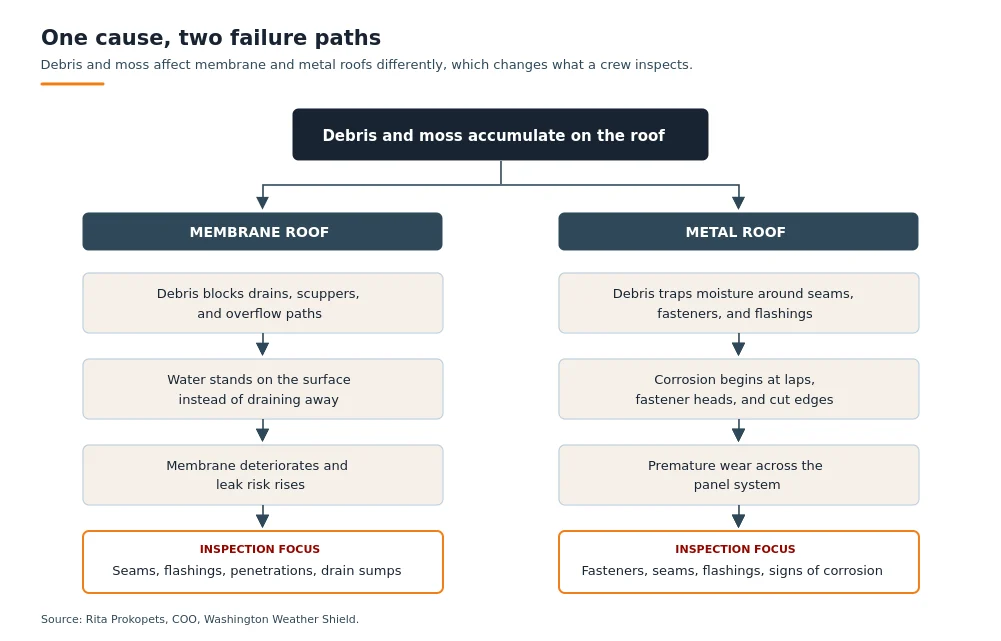
For metal roof maintenance, crews should pay particular attention to fasteners and laps when clearing debris. On membrane systems, the priority shifts toward seams and drain sumps.
One caution when cleaning:
Avoid pressure washing unless the roof manufacturer specifically permits it. High pressure can force water beneath roofing materials or damage the surface.
Interior signs and the deck side
The final part of a commercial roof maintenance checklist is inside the building. At this point, you are looking for signs that water may already have made its way through the roof system.
What to check:
- Ceilings: Look for new stains or discoloration.
- Insulation: Check for damp or compressed areas.
- Fasteners: Watch for visible rust.
- Top-floor spaces: Note any persistent musty smell.
- Exterior walls: Look for staining below roof drainage points.
Photograph anything new and record the date so you can compare conditions during future regular roof maintenance visits.
Why the source of a leak can be hard to find:
The visible stain is rarely directly below the actual leak. Water can travel along decking, joists, and pipe runs before reaching the ceiling, so interior damage may appear 20 feet or more from the breach in the membrane.
That is why interior signs should be treated as evidence of a problem, rather than a reliable indicator of exactly where the roof has failed.
A Manufacturer-Based Inspection Checklist Used by Washington Weather Shield
The visual inspection tips above can help property owners identify potential warning signs between scheduled maintenance visits, but they don’t replace a comprehensive professional roof inspection.
At Washington Weather Shield, our technicians follow a systematic inspection process to evaluate the entire roofing system. As a GAF GoldElite Commercial Contractor, our team is trained to inspect GAF roofing systems in accordance with the manufacturer’s recommended practices, while also applying manufacturer-specific requirements for the many other roofing systems we install and service. The GAF commercial roof maintenance checklist below provides a good example of the thorough approach our technicians take when evaluating a commercial roof.
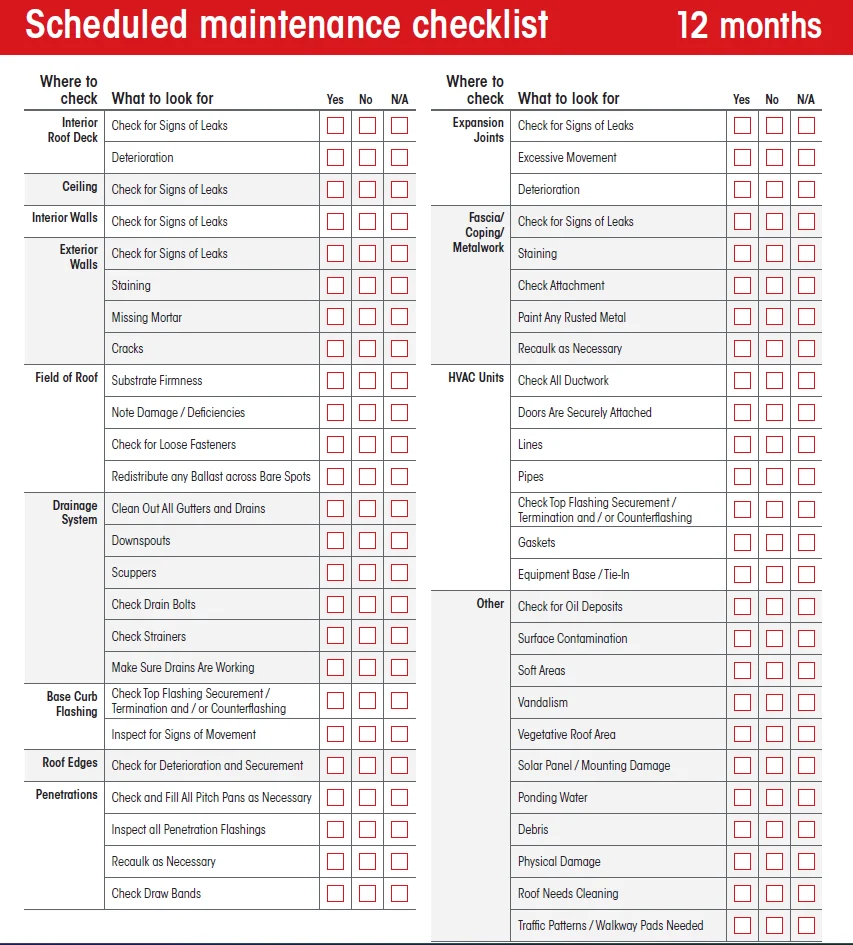
Source: GAF
Flat and metal roofs need different attention
One checklist does not serve both systems, because they fail through different mechanisms on different timelines. A crew trained to look for the wrong failure mode walks straight past the actual problem.
What flat roof maintenance should cover
Flat roof maintenance centers on water that has nowhere to go, making ponding one of the most important conditions to monitor. Ponding should be documented over time, including photographs taken from the same position after significant rainfall.
Persistent ponding in one location points to something structural: inadequate slope, compressed insulation, or deck deflection. A puddle showing up somewhere new usually points to a drain that has stopped working.
Beyond ponding, the priorities are seam condition and the flashing at every transition on the roof. Add membrane wear along traffic routes and the seal at each rooftop equipment penetration. Photo-based reporting matters more here than anywhere else, because most of what you are tracking is gradual.
What a metal roof needs instead
Metal roof maintenance is a fastener and movement problem before it is a water problem. Panels expand and contract through every temperature cycle, and that movement works on the things holding them down.
Check fasteners for backing out, particularly around rooftop units where vibration accelerates it. Check standing seams and side laps for separation, and check sealants at penetrations and terminations. Exposed sealant carries a far shorter service life than the metal panels it protects.
Then check for corrosion, which deserves particular attention in our wet marine climate. Steel roof maintenance in a sustained-wet marine climate means inspecting laps, fastener heads, and cut edges. Those are the places where protective coatings run thinnest and where moisture sits longest after rain. Confirm that valleys and drainage paths are clear, because trapped debris on metal holds water exactly where corrosion starts.
A note for mixed portfolios: multi-family and older commercial properties often carry steep-slope sections alongside the low-slope roof. Shingle roof maintenance runs on its own checks, covering granule loss, lifted or missing shingles, and valley condition. It is worth scheduling separately, but it does not belong on the same inspection form as the low-slope work.
How often should a commercial roof be inspected?
The National Roofing Contractors Association recommends biannual inspections, spring and fall, as the working standard. The goal is catching cracked or loose seams, deteriorated flashing, and drainage blockages before they reach the interior. That is the national baseline, and it is sound.
The regional version is more specific about timing. Regular roof maintenance in the Puget Sound area works best with one visit in late fall, once the leaves have finished dropping. A second visit in late winter or early spring allows accumulated debris to be cleared and any damage from the wet season to be identified.
“For commercial roofs in the Puget Sound area, we recommend one inspection in late fall to clear drains and scuppers ahead of winter storms, followed by another in late winter or early spring to remove accumulated debris and identify damage from the wet season.” – Rita Prokopets, COO, Washington Weather Shield
Several variables move that schedule, including roof age, tree proximity, penetration count, foot traffic, and overall exposure. A ten-year-old roof under mature tree canopy carrying a dozen rooftop units needs more attention than a newer warehouse in an open industrial park.
Some inspections are event-driven rather than scheduled. Add a visit after significant wind, after sustained heavy rain, after rooftop vendor work, and after nearby tree removal.
Seasonal roof care through a Puget Sound year
Most roof maintenance tips published online assume a four-season climate with a hard winter freeze. Ours is a long wet season with a short working window, and the calendar should reflect that.
Late summer through early fall is the repair window, when conditions are dry, adhesives cure properly, and you can schedule work without fighting weather.
Late fall, after leaf drop, is the priority visit, and every drain, scupper, and overflow should be cleared. This is the most valuable service call of the year.
Winter is a time to monitor and respond: track ceiling stains, confirm water is leaving the roof properly, and schedule inspections after significant windstorms when conditions are safe.
Late winter into spring is assessment, clearing accumulated debris and finding what the wet months damaged. Build the repair list before the dry season opens in late summer.
What documentation actually protects you
Photographs turn a commercial roof maintenance plan into a usable maintenance history rather than a folder of invoices.
For each inspection, document:
- The same roof areas from the same positions so conditions can be compared over time
- Enough surrounding context to identify where each photograph was taken
- A scale reference where the size of a defect matters
- The inspector’s name, inspection date, roof section, and weather conditions
Weather conditions matter because ponding cannot be properly assessed on a dry roof.
Use a simple condition-rating system
A red, yellow, and green scale is often more useful than a complicated scoring method. It is easy to understand, survives staff turnover, and makes repair priorities immediately clear to building owners.
Over time, dated photographs and consistent ratings also make long-term budgeting easier. After several years of regular roof maintenance, you can see which areas are deteriorating and plan repairs before they become emergencies.
Keep documentation for warranties and insurance claims
A documented professional roof maintenance record serves two purposes. Manufacturers typically require proof of inspection to keep warranty coverage active, while dated photographs establish the roof’s condition before a storm or other damaging event.
That record can help distinguish new storm damage from pre-existing conditions during an insurance claim.
A note about warranties
The NRCA notes that manufacturer warranties often include provisions that limit the warrantor’s liability. It recommends a formal, long-term maintenance agreement with a professional contractor as more dependable protection.
Warranty coverage is valuable, but it is not a substitute for consistent preventative roof maintenance.
What changes by building type
The checklist stays largely the same across building types. What changes is the potential impact of a leak, which should help determine the appropriate frequency and level of inspection.
Hospitals and clinics. Water over a clinical, surgical, or imaging space stops the function, not only the room. Equipment relocation and infection-control protocols make emergency roof work slow, so prevention is worth more here than anywhere else.
Schools. A leak in an occupied classroom becomes a closure conversation, and summer is the only genuinely low-friction work window. The inspection that matters most is the one that happens in time to schedule repairs before June.
Offices and multi-tenant buildings. The cost arrives as complaint volume, tenant relations, and after-hours access coordination. One ceiling stain in a leased suite generates more work for a property manager than the repair itself.
Warehouses and distribution. High-value inventory often sits beneath large, uninterrupted roof areas, while racking can make interior access difficult. Even a localized leak can damage inventory or disrupt operations before the source is identified.
Industrial facilities. Process equipment raises the stakes below, while exhaust, grease, and chemical deposits change what accumulates above. These buildings usually need more frequent visits than their roof age alone would suggest.
What you can check safely
Some basic conditions can be monitored safely without accessing the roof, while a comprehensive roof inspection should be left to trained professionals.
Safe to check without roof access:
- Interior ceilings and top-floor spaces
- Exterior wall staining below drainage points
- Gutter and downspout condition from grade
- Visible vegetation or debris seen from an adjacent structure
- Anything visible from a permanent, guarded access point without walking the field
Everything else needs someone trained and equipped, because roof access is the most dangerous part of this work. The U.S. Bureau of Labor Statistics reported 110 roofing contractor deaths from falls, slips, and trips in 2023. That was 26.0% of all construction fatalities in that category, the largest share of any construction subsector.
That figure is why professional roof maintenance exists as a service rather than a line on a facilities checklist. It is also why the self-check list above stops where it does.
Frequently asked questions
What is roof maintenance?
Roof maintenance is the scheduled work that keeps a roof performing. It covers debris clearing, drainage, inspection of the details where water enters, and correcting small failures early. Repair responds to a problem that already exists. Roof maintenance is intended to identify and correct small issues before they develop into larger problems.
How often should you do roof maintenance?
Twice a year is the working baseline for most commercial buildings, with extra visits after major weather or rooftop work. Roofs over ten years old, roofs under heavy tree cover, and roofs with many penetrations often justify quarterly attention.
What is the recommended roof maintenance schedule in a wet climate?
Time the two annual visits to the local calendar rather than the generic one. Late fall, after leaf drop, clears drainage before winter storms arrive. Late winter or early spring clears what accumulated and finds the damage the wet months caused.
What maintenance does a metal roof need?
Fasteners, seams, sealants, corrosion, and drainage paths. Panels move with temperature, which loosens fasteners over time, particularly near vibrating rooftop equipment. Exposed sealant at penetrations wears out well before the panels do, and trapped debris holds moisture at laps and fastener heads where corrosion begins.
How does a roof maintenance program work?
A program sets a visit schedule, defines what gets inspected, and produces a written report with dated photographs and condition ratings. Minor corrections such as resealing flashing or clearing drains happen during the visit itself. Larger findings come back as a scoped, prioritized repair recommendation.
How are commercial roof maintenance programs structured?
Most are built around two scheduled visits a year, adjusted for roof age, exposure, and building use, with event-driven inspections after storms. The program should produce documentation the manufacturer will accept for warranty purposes. It should also build a maintenance history you can hand to an insurer or a prospective buyer.
Washington Weather Shield will inspect your roof and photograph each zone included in this commercial roof maintenance checklist. You’ll receive a written condition report that can be shared with ownership and used to plan maintenance or repairs before the next wet season.
References
- National Roofing Contractors Association. Consumer Advisory Bulletin, Issue 4: Maintenance. https://nrcawebstorage.blob.core.windows.net/files/nrca_website/documents/technical/Consumer-Advisory-Bulletin-Issue-4-Maintenance.pdf
- Insurance Institute for Business & Home Safety. Commercial Roofs Best Practices Guide. https://ibhs.org/wp-content/uploads/Commercial-Roofs-Best-Practices.pdf
- Insurance Institute for Business & Home Safety (2022). Building Performance in Southwest Florida During Hurricane Ian: Roof Cover Assessment. https://ibhs.org/wind/building-performance-in-sw-florida-during-hurricane-ian-2022-part1-roof-cover-assessment/
- U.S. Bureau of Labor Statistics (2025). Fatal falls in the construction industry in 2023. https://www.bls.gov/opub/ted/2025/fatal-falls-in-the-construction-industry-in-2023.htm